
Why thirty years of coaching led me from movement-only thinking to an integrated system of Prepare, Perform and Recover
By Jay Morgan
For most of my thirty years as a coach, movement has been the center of my work.
I have studied how people move, how they compensate, how they generate force and how their bodies adapt to training. I have spent decades refining exercise selection, programming, progression and coaching technique. I still believe movement is one of the most powerful tools available to improve health, performance and quality of life.
But experience eventually forced me to confront a difficult truth:
A well-designed workout does not guarantee a successful outcome.
I have watched two people follow similar training programs and achieve very different results. One becomes stronger, moves better and develops momentum. The other struggles to recover, misses sessions, loses consistency or reaches a plateau despite appearing to do the right work.
Earlier in my career, I would have looked almost exclusively at the program.
Was the volume appropriate? Was the exercise selection correct? Did we need to adjust the intensity, frequency or progression?
Those questions still matter. But they are no longer the only questions I ask.
Today, I also want to know how the person slept, what they ate, how they managed stress, whether they were properly hydrated, what demands they faced outside the facility and whether they had the support and structure necessary to remain consistent.
The longer I have coached, the clearer this has become:
The workout creates the stimulus. Your preparation and recovery determine what your body can do with it.
That realization is one of the primary reasons Dynamic Performance & Recovery evolved beyond movement-only coaching.
Movement remains the anchor of our system. But to help someone truly reach a performance goal, we must understand and integrate everything that either supports that goal or creates friction against it.
That is the purpose of our method:
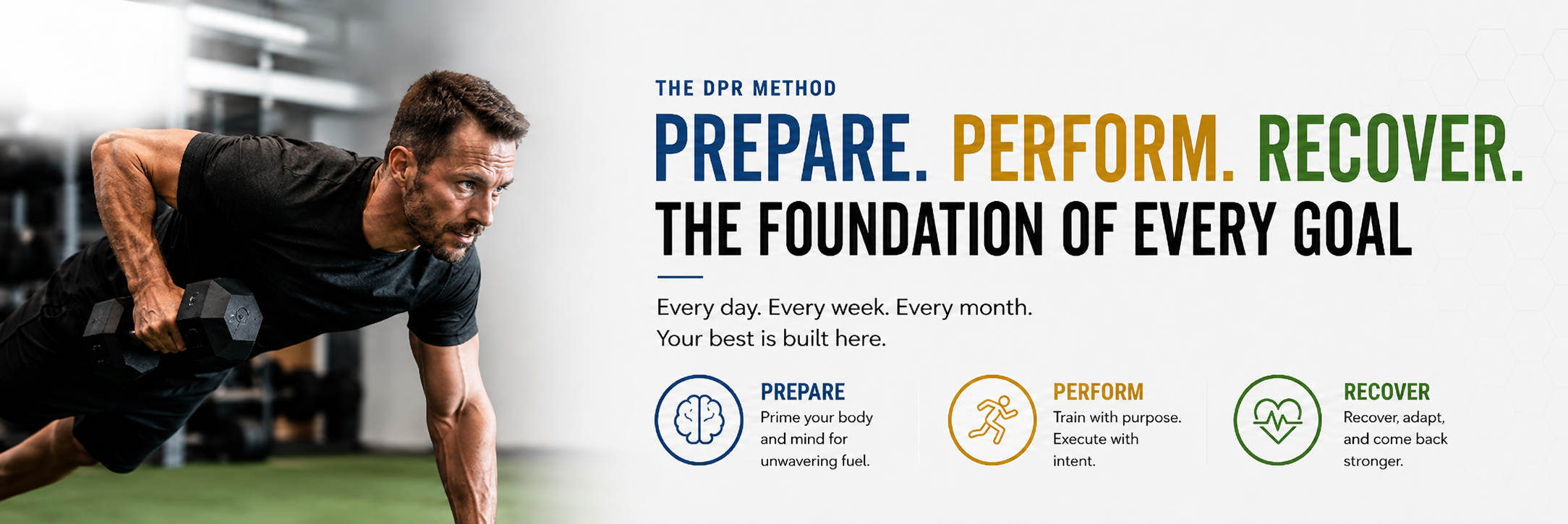
Prepare. Perform. Recover.
Your goal is influenced long before the workout begins
Consider a specific performance goal: improving your VO₂ max.
VO₂ max reflects the body’s ability to take in, transport and use oxygen during intense exercise. Improving it requires an appropriate cardiovascular training stimulus delivered consistently over time.
At first glance, the solution appears straightforward: complete the prescribed metabolic sessions.
But the workout represents only a small portion of the week.
What happens during the remaining hours determines whether the person arrives prepared to execute that session, whether the session produces the intended stimulus and whether the body adequately adapts before the next one.
- Was the person rested enough to sustain the prescribed intensity?
- Were they hydrated?
- Did they consume enough energy to support the work?
- Are they carrying significant mental fatigue?
- Did they recover from the previous session?
- Will they repeat the process consistently next week?
- The VO₂ max goal may be classified as a movement goal, but movement cannot accomplish it independently.
The same is true when the goal is increasing strength, improving power, reducing body fat, returning from an injury or simply moving through life with greater confidence.
Every day, every week and every month, our behaviors are doing one of two things:
They are supporting the goal, or they are creating interference.
Not every imperfect decision will derail progress. Human performance is not that fragile, and perfection is not the expectation. But patterns accumulate. Helpful patterns create momentum. Conflicting patterns create friction.
That is why we organize the process around preparation, performance and recovery rather than viewing the workout as an isolated event.
Prepare: create the conditions to perform
Preparation is everything that allows us to enter a training session ready to benefit from it.
That includes the obvious physical components: hydration, mobility, movement preparation and proper fueling. But preparation also includes mental focus, readiness, breathing mechanics and the ability to transition from the demands of the day into purposeful work.
A client may have the best metabolic workout programmed, but if that person begins the session underhydrated, poorly fueled and mentally exhausted, the workout is no longer being performed under the conditions for which it was designed.
Hydration offers a straightforward example. The American College of Sports Medicine has noted that an appropriate fluid-replacement strategy helps maintain hydration and supports health, safety and physical performance during exercise. The objective is not to drink the greatest possible amount; it is to enter and complete training without excessive fluid or electrolyte disruption.
Preparation also means understanding the purpose of the session.
Are we training aerobic efficiency, muscular strength, movement quality, power or recovery? What adaptation are we trying to produce today?
When people understand the intended outcome, they can better align their effort with the program. More is not always better. A recovery session performed too aggressively can interfere with tomorrow’s high-output session. A strength workout performed without sufficient intent may never provide enough stimulus to create adaptation.
Preparation is not simply warming up.
It is creating the physical, nutritional and psychological conditions necessary to perform the right work at the right level.
Perform: deliver the stimulus with purpose
Performance is where intention becomes action.
This is the training session, the practice, the competition or the purposeful physical challenge. It is where we ask the body to solve a problem and provide a reason to adapt.
But performing effectively is not synonymous with exhausting yourself.
A productive session has a defined target.
A Zone 2 session should create a different physiological demand than a VO₂ interval session. A maximum-strength workout should not feel like a muscular-endurance circuit. A power exercise loses much of its purpose when fatigue slows every repetition.
The quality of the stimulus matters.
That means intensity, volume, exercise selection, rest periods and technique must all align with the intended adaptation. It also means the person must be capable of delivering the required effort that day.
This is where the Prepare phase becomes visible. When readiness is high, the client can execute with greater quality. When readiness is compromised, the coach may need to modify the session without abandoning the larger goal.
Performance is not a daily test of toughness.
It is the disciplined execution of the work most likely to move the individual forward.
Recover: convert effort into adaptation
The session may end when the final repetition is completed, but the training process does not.
Exercise temporarily disrupts the body. Recovery is where the body responds to that disruption, restores resources and begins adapting to better manage the same demand in the future.
That is why recovery cannot be treated as what we do only when we are sore.
Recovery includes sleep, nutrition, stress regulation, appropriate movement, spacing between demanding sessions and the ability to recognize when the body needs restoration rather than another intense stimulus.
A consensus statement on recovery and performance concluded that the balance between training stress, life demands and recovery is essential for sustaining high-level performance. Recovery must address both physiological and psychological fatigue rather than focusing on one in isolation.
This is also where the limits of movement-only coaching become obvious.
A coach can prescribe the correct session, but that session cannot compensate indefinitely for inadequate sleep, chronic stress, insufficient nutrition or inconsistent participation.
The body adapts to the total environment, not merely the hour spent training.
When one pillar weakens, the effects rarely remain isolated
At DPR, we organize health and performance through six interconnected pillars:
Movement, Fuel, Sleep, Resilience, Enhancers and Community.
These are not six unrelated pillars. They are six influences acting on the same human system.
Sleep provides one of the clearest examples.
Imagine someone sleeps poorly for several consecutive nights. The immediate consequence may be fatigue, but the effect does not necessarily stop there.
Training can feel more difficult. Mental focus may decline. The person may have less patience and a reduced capacity to manage stress. Food choices may become more impulsive. Motivation to train may decrease. Recovery from previous sessions may be compromised.
Research supports several links within that chain. Meta-analyses have found that acute sleep loss can impair physical performance, with meaningful effects reported across endurance, speed, power and skill-based tasks.
In a controlled study, one night of total sleep deprivation reduced post-meal muscle protein synthesis and altered the hormonal environment associated with recovery. This does not mean one poor night eliminates progress, but it demonstrates that sleep participates directly in how the body responds to training.
Sleep can also influence the Fuel pillar. Randomized studies have associated restricted sleep with increased hunger, greater snack consumption and higher intake of energy or carbohydrate-rich foods under certain conditions.
That is the interaction we want clients to recognize.
Poor sleep does not simply make someone tired. It can reduce resilience, influence eating behavior, compromise training quality and interfere with recovery. One weakened pillar begins creating friction across several others.
The reverse is also possible.
Better sleep can improve readiness. Greater readiness supports a higher-quality workout. A successful workout reinforces confidence. Confidence makes consistency more likely. Consistency produces measurable progress.
The pillars can create negative interference, or positive momentum.
Resilience is part of physical performance
For years, fitness culture often treated stress as something separate from training. A person entered the gym, completed the program and was expected to leave the rest of life outside the door.
Physiology does not work that way.
The body must respond to training stress while simultaneously managing work pressure, family responsibilities, financial concerns, travel, poor sleep and every other demand placed upon it. Training is one form of stress within a much larger stress budget. Research has shown that higher levels of psychological stress can impair the recovery of muscular function and increase perceived fatigue and soreness following strenuous resistance exercise.
Mental fatigue can also affect the session itself. A systematic review found that mental fatigue commonly reduced endurance performance and increased perceived exertion, the same physical task felt harder to sustain.
This is why resilience is not soft, optional or separate from performance.
Resilience is the ability to regulate our response, restore useful capacity and make an appropriate decision under changing circumstances.
Sometimes resilience means pushing through a difficult but manageable session. Sometimes it means reducing intensity, performing recovery work or protecting the next day’s higher-priority workout.
The goal is not to eliminate stress. The goal is to develop the capacity to respond to it more effectively.
Fuel must support the work being requested
Nutrition is another area where good intentions can conflict with the performance goal.
Someone may want to improve strength while consistently under-consuming protein and total energy. Another person may pursue an aggressive calorie deficit while attempting to increase training volume. Someone performing demanding metabolic work may fail to replace enough carbohydrate to support repeated high-quality sessions.
In each case, the workout and the nutrition strategy are sending competing messages.
Protein provides the structural material needed to repair and remodel muscle tissue. Exercise and protein ingestion work together to stimulate muscle protein synthesis, and adequate daily intake supports the development and maintenance of lean tissue in exercising individuals.
A large meta-analysis found that protein supplementation can enhance gains in muscle strength and fat-free mass during prolonged resistance training, although the benefit depends on the training stimulus and total dietary intake.
This does not mean every client requires a supplement, nor does it mean nutrition must become complicated.
It means the Fuel pillar should support what the Movement pillar is asking the body to accomplish.
Fuel is not simply about eating “good” or “bad” foods. It is about providing enough of the right resources, with sufficient consistency, to support the intended outcome.
Enhancers should enhance a foundation, not replace one
Supplements, recovery technologies and performance tools can be valuable.
Protein powder can help someone meet a protein target. Creatine can support specific training adaptations. Electrolytes can assist an individualized hydration strategy. Magnesium may address a documented need. Wearable data can help identify patterns. Sauna, cold exposure and other recovery modalities can serve particular purposes.
But an enhancer should earn its place by supporting the larger plan. It should not be used to compensate for a missing foundation.
No supplement can consistently overcome inadequate sleep. No recovery device can neutralize a poorly designed training program. No electrolyte product can correct an overall pattern of insufficient fluid intake. No wearable can create behavior change simply by collecting more data.
At DPR, the Enhancers pillar is not intended to be the first step.
It is the strategic layer added after we understand the person, the goal and the primary barriers.
Community turns knowledge into consistency
Most people do not fail because they lack access to information.
They know they should exercise. They know sleep matters. They know hydration and nutrition influence how they feel.
The challenge is converting knowledge into repeated behavior.
That is where coaching and community become important.
A supportive environment provides accountability, feedback, shared expectations and a sense that the person is not pursuing the goal alone. Reviews of exercise adherence have identified social support, professional guidance, goal setting, progress monitoring and self-efficacy among the factors associated with continued participation.
Community does not require everyone to pursue the same goal.
It means creating an environment in which the individual’s goal is understood, reinforced and supported.
The best program has limited value if it is not performed consistently. Community helps protect consistency when motivation changes, life becomes busy or progress temporarily slows.
The question changed my coaching
Earlier in my career, my primary question was:
What movement does this person need?
Today, that remains an essential question, but it is followed by several others.
- What is the actual goal?
- What adaptation is required?
- What is supporting that adaptation?
- What is interfering with it?
- What can this person realistically sustain?
- How do we connect the six pillars without making the plan unnecessarily complicated?
- Those questions changed how I coach.
They moved me away from the belief that every problem could be solved by writing a better workout. They helped me recognize that the workout is only one component of a much larger performance process.
That does not diminish movement. It makes movement more effective.
When Fuel, Sleep, Resilience, Enhancers and Community align around the movement goal, the individual has a better opportunity to train consistently, recover appropriately and produce the adaptation we are seeking.
Prepare. Perform. Recover.
Prepare means creating the conditions to do meaningful work.
Perform means applying the right stimulus with focus and purpose.
Recover means allowing that work to become adaptation.
Those three phases do not occur once.
They repeat every day, every week and every month.
Some days, preparation may mean hydrating, fueling and completing a focused warm-up. Performance may be a demanding strength or metabolic session. Recovery may include protein, mobility, stress regulation and a full night of sleep.
On another day, preparation may involve recognizing accumulated fatigue. Performance may be lower-intensity movement. Recovery may become the primary objective.
The method adjusts, but the principle remains the same:
Every choice either supports the goal, creates friction against it or gives us information that should shape the next decision.
After thirty years of coaching, I still believe deeply in the power of movement. I simply no longer believe movement should be asked to work alone. The strongest results occur when the individual learns to prepare intentionally, perform with purpose and recover well enough to repeat the process.
That is not a supplement strategy.
It is not a workout format.
It is the foundation of sustainable performance.
References
- Craven J, et al. Effects of Acute Sleep Loss on Physical Performance: A Systematic and Meta-Analytical Review. Sports Medicine. 2022.
- Gong M, et al. Effects of Acute Sleep Deprivation on Sporting Performance in Athletes: A Systematic Review and Meta-Analysis. 2024.
- Lamon S, et al. The Effect of Acute Sleep Deprivation on Skeletal Muscle Protein Synthesis and the Hormonal Environment. Physiological Reports. 2021.
- Shimoda S, et al. Effects of Sleep Restriction on Food Intake and Appetite Under Free-Living Conditions: A Randomized Crossover Trial. Appetite. 2023.
- Stults-Kolehmainen MA, et al. Psychological Stress Impairs Short-Term Muscular Recovery from Resistance Exercise.Medicine & Science in Sports & Exercise. 2012.
- Stults-Kolehmainen MA, et al. Chronic Psychological Stress Impairs Recovery of Muscular Function and Somatic Sensations. Journal of Strength and Conditioning Research. 2014.
- Van Cutsem J, et al. The Effects of Mental Fatigue on Physical Performance: A Systematic Review. Sports Medicine. 2017.
- Jäger R, et al. International Society of Sports Nutrition Position Stand: Protein and Exercise. Journal of the International Society of Sports Nutrition. 2017.
- Morton RW, et al. A Systematic Review, Meta-Analysis and Meta-Regression of the Effect of Protein Supplementation on Resistance Training–Induced Gains. British Journal of Sports Medicine. 2018.
- Kellmann M, et al. Recovery and Performance in Sport: Consensus Statement. International Journal of Sports Physiology and Performance. 2018.
- American College of Sports Medicine. Exercise and Fluid Replacement: Position Stand. Medicine & Science in Sports & Exercise.
- Rhodes RE, et al. Psychosocial Factors Associated with Adherence to Exercise Referral Schemes: A Systematic Review.2019.
- Essery R, et al. Key Factors Associated with Adherence to Physical Exercise in Patients with Chronic Diseases and Older Adults: An Umbrella Review. 2021.
ABOUT US
Founded in 2001, The team at Dynamic Health And Fitness believes that individuals must take a proactive, integrated approach on their personal vitality. Our mission is to provide the strategies and techniques necessary for individuals to enhance their lives and also impact those around them. We provide cutting edge programming that fuels our performance center and suite of mobile apps. Our goal is to become a leading resource for individuals, groups, and companies to create a needed shift in health.
The DHF Performance Center is located in the Syracuse, NY area and boasts world class training facilities with cutting edge technology to assist our clients in achieving their health, wellness, and performance goals.