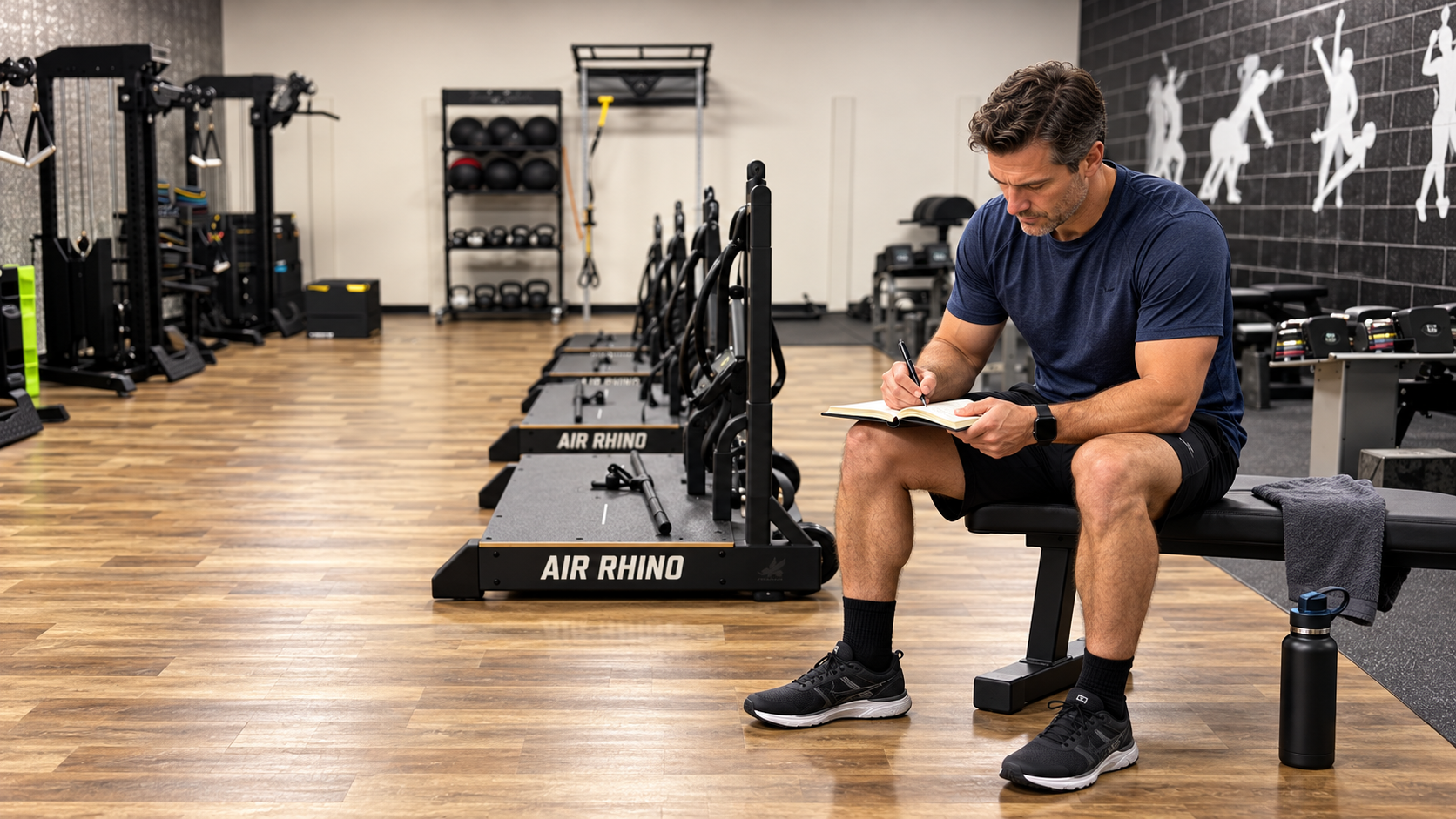
I have a client who began keeping workout journals when he was 18 years old. He is now approaching 50.
Those books contain far more than exercises, sets and repetitions. They document goals he pursued, loads he progressed, movements he modified, periods when training went well and seasons when life changed the plan. They hold notes about energy, injuries, setbacks, confidence and the reasons certain decisions were made.
Together, they tell the story of more than 30 years of training, and of the person doing it.
That kind of history is valuable because a single workout can only show what happened today. A journal helps us understand how today connects to what came before and what should happen next.
A Workout Is an Event. Training Is a Process.
It is easy to judge a workout by how difficult it felt. Did you sweat? Were you tired? Did you lift more weight? Those details can matter, but no single session proves that a program is working.
Progress is created through repeated exposure to an appropriate stimulus, followed by enough recovery for the body to adapt. To evaluate that process, we need more than memory. We need a record.
Research on goal pursuit consistently supports the value of monitoring progress. A large meta-analysis found that prompting people to monitor progress improved goal attainment, with stronger effects when progress was physically recorded or made visible. Research on physical-activity interventions also supports combining goal setting and self-monitoring with feedback and other self-regulation strategies.[1–3]
A journal does not create the adaptation. The work still has to be completed. What it can do is make the work visible enough to evaluate.
Record More Than the Workout
At DPR, Prepare—Perform—Recover describes both the structure inside a workout and the larger cycle surrounding it. Your journal should reflect that full cycle.
Preparation begins before you arrive. Sleep, fueling, hydration, stress, soreness and readiness can influence what you are prepared to do. Performance is the work itself: the exercise, load, repetitions, duration, pace, rest and effort. Recovery is what follows: how you felt later that day, how you slept, whether soreness resolved and whether you were ready for the next exposure.
When those details are recorded consistently, patterns begin to appear. You may discover that performance improves when sleep is more consistent. A repeated ache may appear after a specific progression. A load that once felt difficult may become routine. A plateau may reveal that the program stopped progressing, or that recovery was no longer supporting the work.
Progress tells us what worked. Regression can help us identify what changed.
Even a simple rating of session difficulty has value. Research has shown that session rating of perceived exertion can provide a practical way to quantify training load across different types of exercise.[4] The journal does not have to be complicated. It has to be accurate enough to help you and your coach make a better next decision.
The Plan and the Record Have Different Jobs
The DPR app and the DPR Workout Journal are designed to work together, but they are not meant to do the same thing.
The app holds the plan. It delivers your assigned workouts, exercise demonstrations, screening information, goals, modifications and coaching direction. The journal records the work that was actually completed: what you did, how much you did, how it felt and what should be remembered before the next session.
That distinction matters because a prescribed program and a completed program are not always identical. Travel, pain, fatigue, equipment, time and readiness can change what happens on a given day. Writing down the adjustment preserves the reasoning instead of allowing it to disappear.
The journal also creates continuity between coached sessions and independent training. Your coach can see what occurred away from DPR, and you can carry the intent of the coached program into the work you complete on your own.
A Journal Supports Coaching; It Does Not Replace Assessment
A training journal is a record of experience, not a medical test and not an exact measurement of every physiological change. Research specifically examining paper training diaries found that they may support monitoring, but should not replace objective performance testing when precise measurement is needed.[5]
That is exactly how the journal should be used: as context.
The entries help us ask better questions. Did the program progress? Was the planned work completed? Was the effort appropriate? Did readiness change? Is the goal still meaningful? Do we need to adjust the training dose, the recovery strategy or the measurement itself?
Modern resistance-training guidance continues to emphasize that outcomes depend on how training variables are prescribed and progressed over time.[6] If we want to individualize those variables, we need an honest account of how the person responded, not merely a list of what was scheduled.
Your Future Self Will Not Remember Everything
Most people believe they will remember the important workouts, the difficult periods and the moments when progress began. Over months and years, the details blur.
The client who began journaling at 18 does not have to guess what he was doing at 25, how he trained through a setback at 34 or what changed when a goal finally moved forward. He can return to the record.
The journals do not show a perfectly straight line. They show adaptation, interruption, adjustment and return.
That is real training.
You do not need decades of entries before a journal becomes useful. Begin with the next workout. Record the goal, the work and the response. Note what you want to repeat and what may need to change. Then bring that information forward.
A workout happens once. A well-kept journal allows the lesson to keep working.
References
-
Harkin B, Webb TL, Chang BPI, et al. Does monitoring goal progress promote goal attainment? A meta-analysis of the experimental evidence. Psychological Bulletin. 2016;142(2):198–229. doi:10.1037/bul0000025. https://pubmed.ncbi.nlm.nih.gov/26479070/
-
McEwan D, Harden SM, Zumbo BD, et al. The effectiveness of multi-component goal setting interventions for changing physical activity behaviour: a systematic review and meta-analysis. Health Psychology Review. 2016;10(1):67–88. doi:10.1080/17437199.2015.1104258. https://pubmed.ncbi.nlm.nih.gov/26445201/
-
Michie S, Abraham C, Whittington C, McAteer J, Gupta S. Effective techniques in healthy eating and physical activity interventions: a meta-regression. Health Psychology. 2009;28(6):690–701. doi:10.1037/a0016136. https://pubmed.ncbi.nlm.nih.gov/19916637/
-
Foster C, Florhaug JA, Franklin J, et al. A new approach to monitoring exercise training. Journal of Strength and Conditioning Research. 2001;15(1):109–115. PMID:11708692. https://pubmed.ncbi.nlm.nih.gov/11708692/
-
Schukro C, Emich M, Fritzer-Szekeres M, Strametz-Juranek J, Sponder M. Paper-based training diaries for monitoring of performance progress due to long-term physical activity. Polish Archives of Internal Medicine. 2019;129(10):679–685. doi:10.20452/pamw.14975. https://pubmed.ncbi.nlm.nih.gov/31527560/
-
Currier BS, D’Souza AC, Fiatarone Singh MA, et al. American College of Sports Medicine Position Stand. Resistance Training Prescription for Muscle Function, Hypertrophy, and Physical Performance in Healthy Adults: An Overview of Reviews. Medicine & Science in Sports & Exercise. 2026;58(4):851–872. doi:10.1249/MSS.0000000000003897. https://pubmed.ncbi.nlm.nih.gov/41843416/
ABOUT US
Founded in 2001, The team at Dynamic Health And Fitness believes that individuals must take a proactive, integrated approach on their personal vitality. Our mission is to provide the strategies and techniques necessary for individuals to enhance their lives and also impact those around them. We provide cutting edge programming that fuels our performance center and suite of mobile apps. Our goal is to become a leading resource for individuals, groups, and companies to create a needed shift in health.
The DHF Performance Center is located in the Syracuse, NY area and boasts world class training facilities with cutting edge technology to assist our clients in achieving their health, wellness, and performance goals.