Training Methods Are Tools: How Much Work Do You Really Need?
I began resistance training when I was approximately 13 years old. Over the four decades since, I have trained at nearly every point on the volume-and-intensity spectrum.
At times, I trained as often as three times per day using a Bulgarian-inspired, high-frequency system. I followed traditional bodybuilding splits built around high training volume. At the opposite extreme, I experimented with the low-volume, high-effort philosophies associated with Mike Mentzer and Dorian Yates. I have used interval training, circuits, sport-specific programs and many of the methods that have moved in and out of popularity.
Most of them produced some type of result.
What changed was the result being pursued, the demands placed on my body, the amount of time required and how well I could recover from the work.
That experience taught me something important:
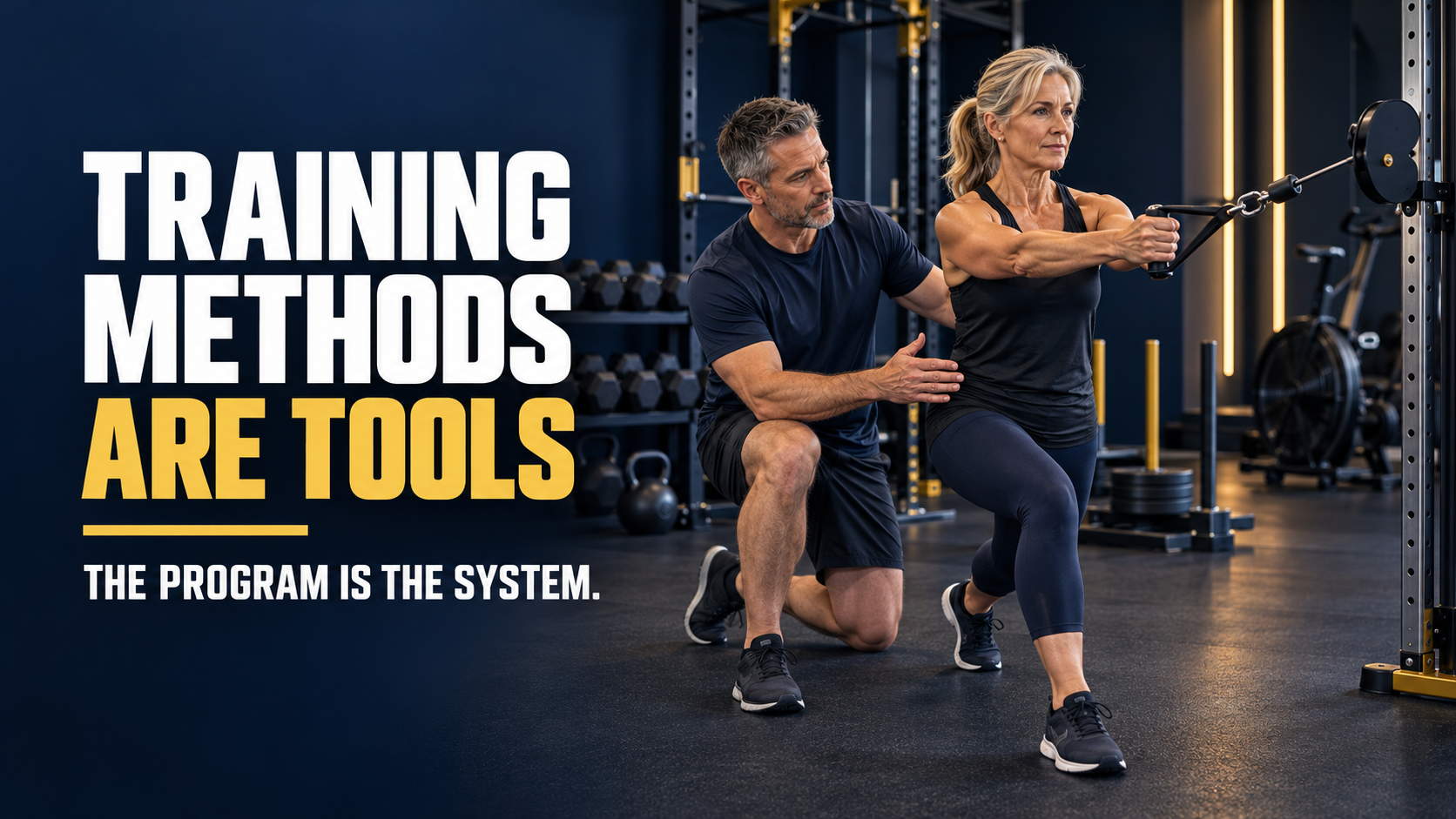
A training method is a tool. The program is the system that determines when, why and how much of that tool should be used.
From More Work to Harder Work
Different training philosophies developed around different sports, cultures and objectives.
Eastern European weightlifting systems became known for planned training blocks, concentrated loading and frequent practice of the competition lifts. The Bulgarian system moved toward the extreme end of that spectrum, with highly specialized athletes practicing a limited number of lifts multiple times per day.
Western bodybuilding culture often emphasized higher-volume split routines, dedicating separate training days to individual muscles or body regions. Mike Mentzer and, later, Dorian Yates challenged that approach by reducing the number of working sets and increasing the effort applied to each set.
Powerlifting organized training around maximal strength in the squat, bench press and deadlift. Endurance programs emphasized the ability to sustain movement over time. Interval training compressed demanding cardiovascular work into shorter periods. CrossFit combined strength, skill and conditioning, while HYROX created a standardized event combining eight one-kilometer runs with eight functional workout stations.
These methods were not created to solve the same problem. Comparing them without considering their intended purpose is like comparing a hammer, a screwdriver and a saw and asking which is the best tool.
The answer depends on what you are trying to build.
Different Methods Solve Different Problems
Bodybuilding Splits
Bodybuilding programs commonly distribute higher training volume across separate body parts or movement groups. They can be effective for developing muscle mass, particularly when muscle growth is the primary objective.
The tradeoff is time. A traditional split may require several weekly sessions to provide enough frequency across the entire body. It may also prioritize isolated muscular development over the balance, movement variability, power and aerobic capacity needed for a broader active-aging program.
Powerlifting
Powerlifting organizes training around producing maximal force in the squat, bench press and deadlift. It is highly effective for developing strength in those specific lifts.
However, the technical demands and narrow exercise focus may not address every quality required by the average adult. Powerlifting movements can be valuable tools without requiring the individual’s entire program to become a powerlifting program.
High-Intensity Resistance Training
The systems associated with Mike Mentzer and Dorian Yates use fewer working sets performed with extremely high effort. This can reduce the amount of time spent training while still providing a meaningful muscular stimulus.
However, low volume does not mean low demand. Repeatedly training to muscular failure can create substantial fatigue and requires excellent technique, appropriate exercise selection and sufficient recovery.
Research indicates that reaching complete muscular failure on every set is not required to improve strength or muscle mass. Hard sets can be productive without every set becoming a maximal physical test.[1]
Bulgarian-Inspired High-Frequency Training
Bulgarian-style weightlifting emphasized frequent practice with a limited number of competition lifts, sometimes through multiple sessions in one day.
This approach was designed for specialized athletes whose sport, lifestyle and recovery resources supported an extraordinary amount of focused training. It may improve skill and force production in specific lifts, but it is not an appropriate general template for most active-aging adults.
More frequent practice only helps when the person can recover from it and when the movement being practiced directly supports the goal.
CrossFit and Mixed-Modal Conditioning
CrossFit combines strength, skill, power and cardiovascular conditioning within varied workouts. It can develop broad work capacity and provide a strong sense of community when exercises and intensity are appropriately coached and scaled.
Four or five CrossFit sessions per week do not automatically constitute overtraining. The real question is whether four or five demanding sessions, combined with the person’s experience, sleep, work stress, family responsibilities and other activities, create more fatigue than that individual can recover from.
Research does not support labeling CrossFit as universally unsafe. Injury risk is influenced by training experience, frequency, exercise selection, technical skill, supervision and how appropriately the workload is progressed.[2]
HYROX Training
HYROX combines eight one-kilometer runs with eight functional workout stations. Preparing for it can improve running capacity, muscular endurance and the ability to continue producing work while fatigued.
If completing or competing in HYROX is the goal, the specificity of the program is an advantage. If that is not the goal, repeatedly duplicating the event’s demands may create unnecessary running volume or muscular fatigue without addressing other important physical qualities.
The activity determines the task. The task should help determine the training.
Endurance and Interval Training
Continuous endurance work develops the ability to sustain activity and produce energy efficiently. Interval training exposes the body to periods of greater cardiovascular demand separated by planned recovery.
Both are useful, but they produce different responses. High-intensity intervals cannot completely replace lower-intensity aerobic development, and every cardiovascular session should not become a maximal test.
The correct balance depends on the person’s goal, starting capacity, training history and ability to recover.
Sport-Specific Training
Sport-specific programs prepare someone for the skills and physical demands of a chosen activity. Specificity is important, but playing a sport does not guarantee the development of every physical quality needed to remain healthy and capable.
A golfer, runner, cyclist or pickleball player may still need dedicated strength, power, mobility, balance and recovery work. The sport provides the reason for training, but it does not always provide the complete program.
Volume, Intensity and the Recoverable Dose
The name of a training method tells us less than many people think. The actual response is determined by how the method is dosed.
Volume describes how much work is completed.
Intensity can describe the load being lifted, the cardiovascular demand or how close an effort comes to the person’s current limit.
Frequency describes how often the stimulus is repeated.
Density describes how much work is compressed into a period of time.
These variables must work together.
Research generally demonstrates that increasing resistance-training volume can produce additional muscle development, but additional work is not automatically better for every person or every goal.[3]
The 2026 American College of Sports Medicine position stand concluded that resistance training improves strength, muscular development and physical performance across a wide range of program designs. The most effective prescription depends on the desired outcome, and meaningful results do not require an unnecessarily complicated or extreme program.[4]
The goal is to provide enough stress to move beyond the body’s current functional threshold and create a reason to adapt, without repeatedly exceeding the person’s ability to recover.
The objective is not to perform the greatest amount of work you can survive. It is to perform the appropriate amount of work from which you can adapt.
Your Schedule Is Part of the Program
A theoretically perfect program has little value if it cannot survive a person’s actual life.
Before determining how many exercises, sets or training days someone needs, we should ask a practical question:
How much time can this person consistently protect after accounting for work, family, travel and other responsibilities?
That does not mean settling for an ineffective program. It means organizing the highest-value work within the time that is realistically available.
Someone who can consistently train twice per week needs a different structure than someone who can reliably train four days. Within DPR’s four-workout model, the two-day client completes the sequence across two weeks. A three-day client carries the rotation into the following week. A four-day client completes the entire rotation each week.
The system remains intact. The schedule determines the pace.
When time is limited, the program should prioritize the movement patterns and physical qualities most closely connected to the person’s goal. Multi-joint exercises, full-body sessions and carefully paired movements can make training more efficient without making it incomplete. Research examining time-efficient resistance training supports prioritizing major movement patterns when available training time is limited.[5]
What should not be carelessly removed is the preparation needed to move well, the recovery required between demanding efforts or the coaching necessary to maintain quality.
A sustainable two-day program is more valuable than an impressive five-day program that repeatedly collapses under the pressure of work and family life.
The program must fit into someone’s life before it can improve that life.
Readiness Determines Today’s Dose
Even when the goal and schedule are clear, the appropriate training dose can change from one day to another.
Daily readiness should be considered through three lenses.
Mentally, is the person focused, motivated and prepared to engage with the session?
Physically, are there unusual symptoms, joint concerns, excessive soreness or a noticeable decline in performance?
Foundationally, has the person slept, fueled and hydrated adequately, or are illness and outside stress changing the recovery picture?
Wearable technology such as an Apple Watch or WHOOP can add information through sleep trends, resting heart rate and heart-rate variability. Research suggests that HRV can contribute to individualized endurance-training decisions.[6]
These measurements should be treated as inputs, not commands. A single readiness score cannot replace the person’s experience, the coach’s observation or an understanding of what is occurring outside the gym.
Some days are appropriate for progressing the stimulus. Other days call for sustaining the current workload, reducing volume, changing the method or emphasizing recovery.
That is not a failure of the program.
That is the program responding intelligently.
The Active-Aging Goal Is Usable Capacity
For an active-aging client, training should not become a recurring test of how much discomfort the person can tolerate.
The purpose is to develop and retain the physical qualities that allow someone to participate fully in life: strength, power, aerobic capacity, balance, mobility, muscular endurance and confidence.
That still requires challenge. The body will not adapt without being asked to do something beyond what it can already perform comfortably. However, the stimulus must be introduced progressively and with respect for the person’s health history, experience, goals, schedule and recovery resources.
We need to push the functional threshold without routinely surpassing the recoverable threshold.
The appropriate method might be a heavy strength set, an isometric hold, controlled tempo work, a superset, a circuit, an interval or a longer aerobic session. Its value depends on why it was selected and how it contributes to the larger plan.
Start With the Person—Not the Method
Before selecting a training method, we should be able to answer several questions.
What is the person trying to accomplish?
What physical qualities does that goal require?
What is the person currently prepared to tolerate?
How much time can the person consistently provide?
What other demands are competing for recovery?
How will we measure whether the program is working?
Only then should we decide how much volume, intensity, frequency and density are appropriate.
After more than four decades of experimenting with nearly every training extreme, I do not believe there is one superior method for everyone.
The best method is the one required by the goal, delivered at a dose the individual can recover from and organized within a schedule the person can realistically sustain.
The method creates the stimulus.
The program organizes the work.
The system gives it direction.
References
-
Grgic J, Schoenfeld BJ, Orazem J, Sabol F. Effects of resistance training performed to repetition failure or non-failure on muscular strength and hypertrophy: A systematic review and meta-analysis. Journal of Sport and Health Science. 2022;11(2):202–211. doi: 10.1016/j.jshs.2021.01.007
-
Rodríguez MÁ, García-Calleja P, Terrados N, Crespo I, Del Valle M, Olmedillas H. Injury in CrossFit: A systematic review of epidemiology and risk factors. The Physician and Sportsmedicine. 2022;50(1):3–10. doi: 10.1080/00913847.2020.1864675
-
Schoenfeld BJ, Ogborn D, Krieger JW. Dose-response relationship between weekly resistance-training volume and increases in muscle mass: A systematic review and meta-analysis. Journal of Sports Sciences. 2017;35(11):1073–1082. doi: 10.1080/02640414.2016.1210197
-
Currier BS, D’Souza AC, Fiatarone Singh MA, et al. American College of Sports Medicine Position Stand: Resistance training prescription for muscle function, hypertrophy, and physical performance in healthy adults—an overview of reviews. Medicine & Science in Sports & Exercise. 2026;58(4):851–872. doi: 10.1249/MSS.0000000000003897
-
Iversen VM, Norum M, Schoenfeld BJ, Fimland MS. No time to lift? Designing time-efficient training programs for strength and hypertrophy: A narrative review. Sports Medicine. 2021;51(10):2079–2095. doi: 10.1007/s40279-021-01490-1
-
Vesterinen V, Nummela A, Heikura I, Laine T, Hynynen E, Botella J, Häkkinen K. Individual endurance training prescription with heart-rate variability. Medicine & Science in Sports & Exercise. 2016;48(7):1347–1354. doi: 10.1249/MSS.0000000000000910
ABOUT US
Founded in 2001, The team at Dynamic Health And Fitness believes that individuals must take a proactive, integrated approach on their personal vitality. Our mission is to provide the strategies and techniques necessary for individuals to enhance their lives and also impact those around them. We provide cutting edge programming that fuels our performance center and suite of mobile apps. Our goal is to become a leading resource for individuals, groups, and companies to create a needed shift in health.
The DHF Performance Center is located in the Syracuse, NY area and boasts world class training facilities with cutting edge technology to assist our clients in achieving their health, wellness, and performance goals.