Health is often divided into separate categories. We talk about exercise, nutrition, sleep and stress as if each exists on its own.
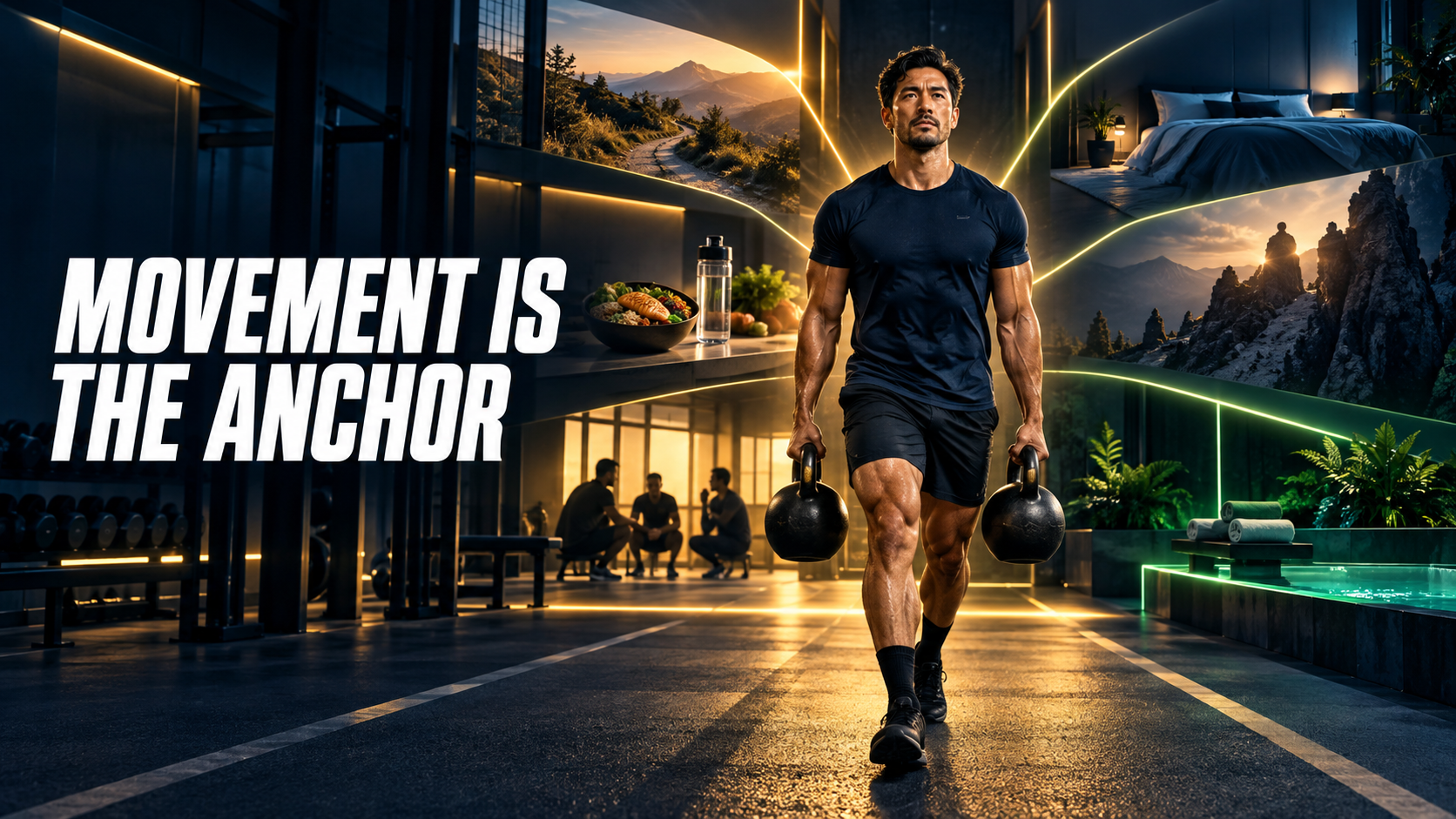
At DPR, the six Vitality Pillars are designed to work together. Movement is the anchor, not because it is more important than Fuel, Sleep, Resilience, Community or Enhancers, but because it gives every pillar a result to support.
Once we understand what you want your body to do, the rest of the system gains direction.
From Information to a Movement Goal
A screening provides insight into where you are today. It may identify current strengths, limitations and opportunities, but the numbers alone do not determine your goal.
We also need to understand what matters to you.
Do you want to improve your mile time? Increase your VO₂ max? Build grip strength? Carry more weight? Improve your body composition? Return to a sport? Get off the floor more confidently? Remain capable enough to travel, play with your grandchildren and live independently?
Those are not simply exercise preferences. They are meaningful outcomes that help us establish a measurable Movement goal.
The goal becomes the anchor. The program becomes the path.
Perform Is Where You Practice Your Craft
Perform is the exciting part of the system. It is where you lift, carry, run, push, pull, rotate and practice the physical qualities your goal requires.
If your goal is to improve your mile time, the program cannot consist only of running harder. You may need to develop aerobic capacity, lower-body strength, running economy, tissue tolerance and the ability to maintain your mechanics as fatigue increases.
If your goal is to improve grip strength, squeezing a dynamometer is only the measurement. The program may include carrying, pulling, hanging, trunk control and progressively handling heavier loads.
If your goal is to improve body composition and metabolic health, strength and conditioning create an important stimulus, but the result will also be influenced by your fueling, sleep, stress, daily movement and consistency.
Perform is where you practice the goal. It is not the only place where progress is created.
Prepare Makes the Work Possible
Preparation begins before you enter the gym.
The sleep you received, the food you ate, your hydration, your stress level and your readiness all influence what your body can produce during training.
Inside the workout, Prepare helps you regulate, mobilize, activate and rehearse. It is designed to help you transition from wherever you are when you arrive toward what the upcoming work requires.
Preparation is not a collection of movements completed before the “real workout.” It is part of the process that allows you to perform the work well.
Recover Helps the Body Adapt
The workout creates the stimulus. Recovery helps determine what your body does with it.
Recovery begins inside the session as intensity changes and concludes with intentional regulation. It continues after you leave through refueling, hydration, sleep, stress management and the movement you perform throughout the rest of your day.
Today’s recovery also becomes preparation for what you ask your body to do next.
This is why Prepare, Perform and Recover cannot be treated as three unrelated sections. They form a continuous cycle organized around the result you are trying to achieve.
Give Every Pillar a Job
A meaningful Movement goal gives every Vitality Pillar a purpose.
Fuel helps provide the energy and nutrients required to train and adapt. Sleep supports readiness, learning and recovery. Resilience influences how effectively you regulate stress and remain consistent. Community provides support, accountability and connection. Enhancers can add useful strategies when they serve the goal rather than distract from it.
Movement brings those contributions together in something you can practice, experience and measure.
Without a clear goal, the pillars can become a collection of healthy behaviors. With a goal, they become a coordinated system.
Match the Goal to the Time Available
An 8-to-12-week goal should be focused and measurable. It might be improving a mile time, increasing grip strength, progressing a loaded carry, raising aerobic capacity or establishing an initial body-composition trend.
A six-month goal allows enough time to move through several phases of training, build broader physical capacity and make more substantial progress.
A 12-month goal can connect those shorter phases to a larger outcome: completing an event, reaching a significant strength or endurance benchmark, improving metabolic health or building the capacity required to remain active and independent.
The longer goal establishes direction. The shorter goals create measurable milestones along the way.
Build a Goal Your Program Can Use
A useful Movement goal identifies what you want your body to be able to do, why that ability matters, how progress will be measured and what you can realistically practice over the next 8 to 12 weeks.
Once those answers are clear, the entire system becomes more purposeful. We know what Perform must develop, what Prepare must make you ready to do and which Recovery strategies deserve the most attention.
Movement is the anchor because it gives every pillar something meaningful to support.
The workout is where you practice your craft. Everything surrounding it helps determine what that practice becomes.
References
- Garber CE, Blissmer B, Deschenes MR, et al. American College of Sports Medicine Position Stand: Quantity and Quality of Exercise for Developing and Maintaining Cardiorespiratory, Musculoskeletal, and Neuromotor Fitness in Apparently Healthy Adults. Medicine & Science in Sports & Exercise. 2011;43(7):1334–1359.
- McEwan D, Harden SM, Zumbo BD, et al. The Effectiveness of Multi-Component Goal Setting Interventions for Changing Physical Activity Behaviour: A Systematic Review and Meta-Analysis. Health Psychology Review. 2016;10(1):67–88.
- Thomas DT, Erdman KA, Burke LM. Position of the Academy of Nutrition and Dietetics, Dietitians of Canada, and the American College of Sports Medicine: Nutrition and Athletic Performance. Journal of the Academy of Nutrition and Dietetics. 2016;116(3):501–528.
- Walsh NP, Halson SL, Sargent C, et al. Sleep and the Athlete: Narrative Review and 2021 Expert Consensus Recommendations. British Journal of Sports Medicine. 2021;55(7):356–368.
- Kellmann M, Bertollo M, Bosquet L, et al. Recovery and Performance in Sport: Consensus Statement. International Journal of Sports Physiology and Performance. 2018;13(2):240–245.
- Sawka MN, Burke LM, Eichner ER, Maughan RJ, Montain SJ, Stachenfeld NS. American College of Sports Medicine Position Stand: Exercise and Fluid Replacement. Medicine & Science in Sports & Exercise. 2007;39(2):377–390.
ABOUT US
Founded in 2001, The team at Dynamic Health And Fitness believes that individuals must take a proactive, integrated approach on their personal vitality. Our mission is to provide the strategies and techniques necessary for individuals to enhance their lives and also impact those around them. We provide cutting edge programming that fuels our performance center and suite of mobile apps. Our goal is to become a leading resource for individuals, groups, and companies to create a needed shift in health.
The DHF Performance Center is located in the Syracuse, NY area and boasts world class training facilities with cutting edge technology to assist our clients in achieving their health, wellness, and performance goals.