







Most people know they should move more.
The harder question is knowing how to move more without overdoing it — and how to choose the type of movement that actually helps your body become more capable.
Some people need to walk more. Some need to restore mobility. Some need to rebuild strength. Some need better conditioning. Others are already active, but their movement is too narrow, too repetitive, or missing important qualities like balance, power, recovery, or whole-body strength.
That is why Move More. Move Well. is one of the foundational habits inside the Vitality system.
This habit is not about exercising harder for the sake of intensity. It is about building a repeatable movement rhythm while improving the quality, variety, and purpose of how your body moves.
The goal is simple:
Move more often. Move with better purpose. Build a body that stays capable.
What Does “Move More. Move Well.” Mean?
The phrase has two parts, and both matter.
Move More means increasing the amount of movement in your life. This may include walking, mobility work, strength training, aerobic conditioning, power training, sport, recovery movement, or short movement breaks built into your day.
Movement does not only count when it is intense. A walk counts. Mobility counts. A short strength circuit counts. Getting on and off the ground counts. Carrying, reaching, rotating, climbing stairs, and practicing balance all count when they are done with intention.
Move Well means improving the quality and usefulness of that movement.
A body that moves well can reach, rotate, bend, squat, lunge, push, pull, carry, walk, balance, and recover from effort with more confidence. Moving well does not mean moving perfectly. It means your body has access to more options.
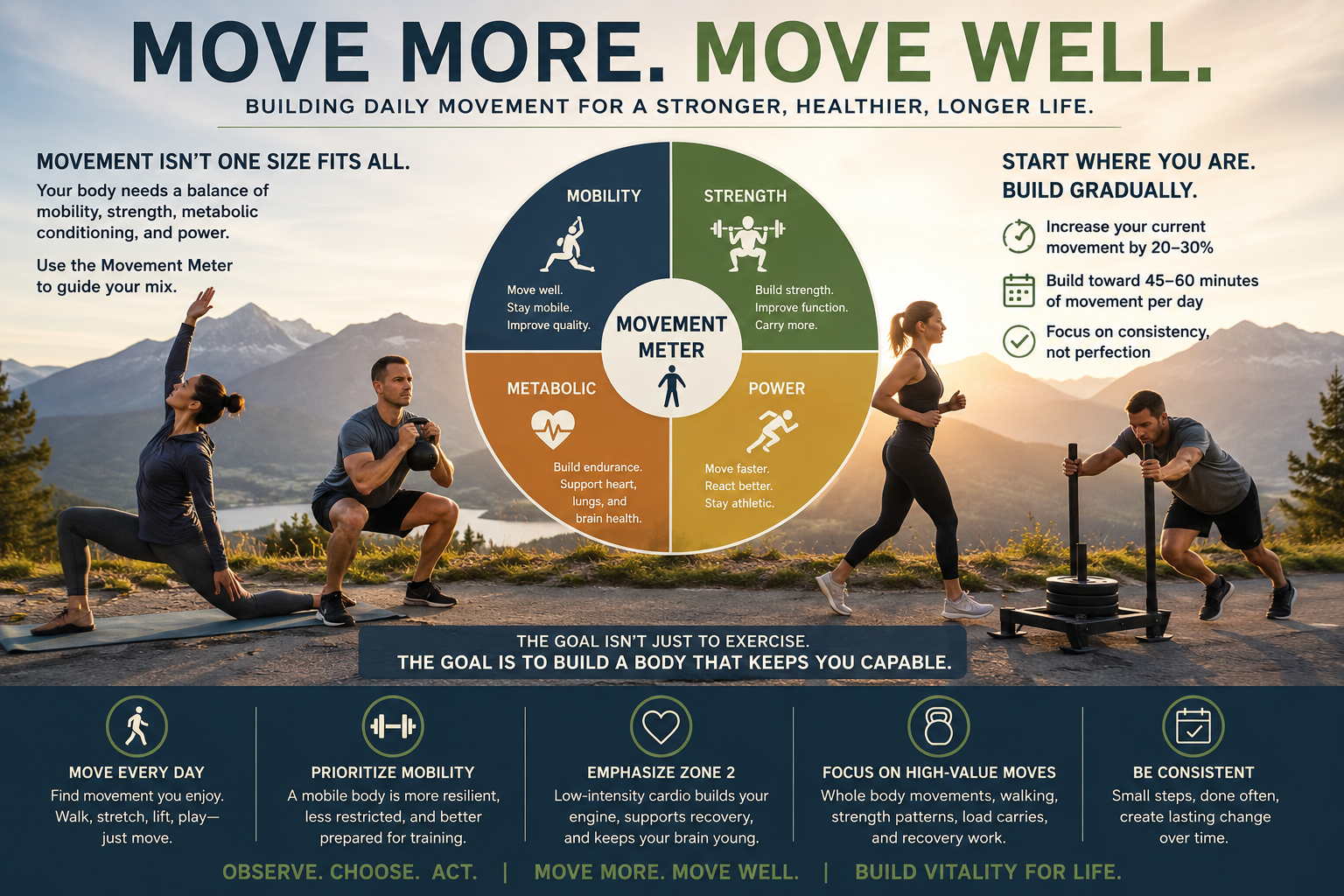
Inside Vitality, we organize the Movement pillar into four major categories: mobility, strength, metabolic work, and power.
Mobility helps restore access to movement. Strength helps you produce and control force. Metabolic work helps build endurance, energy capacity, and cardiovascular support. Power helps preserve speed, reactivity, coordination, and athleticism as you age.
A complete movement life does not require you to train all four categories aggressively at the same time. But over time, the body benefits from exposure to all four.
This is why the Vitality system uses the Movement Meter. It gives you a simple way to see whether your week includes the right mix of movement qualities or whether one area needs more attention.
Why This Habit Matters
Movement is one of the strongest levers for long-term health because it touches nearly every other Vitality pillar.
It can support sleep quality, metabolic health, strength, balance, mood, energy, body composition, resilience, and your ability to participate in the activities that make life meaningful.
Public health guidelines consistently recommend that adults accumulate regular aerobic activity and include muscle-strengthening work during the week. The CDC recommends at least 150 minutes of moderate-intensity physical activity each week, along with at least two days of muscle-strengthening activity. The World Health Organization recommends 150–300 minutes of moderate-intensity aerobic activity per week, or an equivalent amount of vigorous activity, plus muscle-strengthening activities on two or more days weekly.
But guidelines are only part of the story.
At Dynamic Performance & Recovery, we care about what those numbers mean in real life.
Can you get off the ground? Can you carry groceries? Can you walk hills or stairs without feeling limited? Can you rotate, reach, and bend with confidence? Can you play with your kids or grandkids? Can you train, travel, compete, garden, golf, play pickleball, or live your life without your body constantly telling you “no”?
When movement declines, life often gets smaller.
You avoid stairs. You avoid lifting. You avoid getting on the ground. You avoid sports. You avoid long walks. You avoid activities that used to feel normal.
When movement improves, life expands again.
That is why this habit is foundational.
It is not about chasing a workout trend. It is about preserving and building the physical capacity that allows you to keep participating in your life.
Start Where You Are
One of the biggest mistakes people make with movement is trying to jump from their current reality to an idealized version of what they think they should be doing.
They go from inconsistent activity to five hard workouts per week. They go from stiffness and soreness to aggressive strength training. They go from no conditioning to long cardio sessions. They try to make up for months or years of undertraining in two weeks.
That usually does not last.
A better starting point is to increase your current movement volume by a manageable amount. Inside the Vitality system, we often think in terms of building by 20–30% more than what you are doing now.
If you are moving 10 minutes per day, the next step may be 12–15 minutes.
If you are walking twice per week, the next step may be adding a third walk.
If you are doing one strength session per week, the next step may be adding a short second session.
If you are already training regularly, the next step may not be more intensity. It may be better balance across mobility, strength, metabolic work, and power.
The goal is to build gradually toward 45–60 minutes of movement per day, spread across your week. That does not mean every day needs to be a formal workout. It means your week should include enough total movement to support health, capacity, and consistency.
Movement works best when it becomes part of your rhythm, not another unrealistic demand you are trying to force into your life.
Use the Movement Meter to Guide the Mix
The Movement Meter helps you look beyond the question, “Did I work out?”
A better question is:
What kind of movement did I give my body this week?
If your week is all walking but no strength, you may be missing force production.
If your week is all strength but no mobility, you may be missing movement quality.
If your week is all mobility but no conditioning, you may be missing metabolic capacity.
If your week has no power, speed, or reactivity, you may be missing qualities that help preserve athleticism and confidence as you age.
The Movement Meter is not meant to create pressure. It is meant to create awareness.
A balanced movement rhythm includes mobility, strength, metabolic work, and power. But balance does not always mean equal emphasis. Your current phase matters.
If you are just starting, rebuilding, managing discomfort, or coming back after time away, mobility often deserves first priority. A body that moves better is usually better prepared to tolerate strength, conditioning, and power.
From there, strength becomes essential because strength is what allows you to control your body, handle load, and maintain function. Research on functional training in older adults supports the value of training movement patterns that carry over into daily life, including activities such as rising from a chair, climbing stairs, walking, balance, mobility, and other daily tasks.
Metabolic conditioning also matters, especially lower-intensity aerobic work that you can repeat consistently. In the Vitality system, this often includes Zone 2-style conditioning, performed at a pace where you can still speak in short sentences and sustain the effort. This type of training is useful because it builds aerobic capacity without creating excessive stress.
Power should be introduced progressively and appropriately. For some clients, power may start with simple rhythm, balance, stepping, reaching, or low-level medicine ball work. It does not need to begin with jumping or high-impact drills. The principle is to preserve the ability to move with speed and coordination, at the right level for the individual.
How to Choose the Right Movement Today
This is where Habit #1 connects directly to Habit #2.
Your Daily Readiness Observation helps you notice where you are starting from. Move More. Move Well. helps you decide what to do with that information.
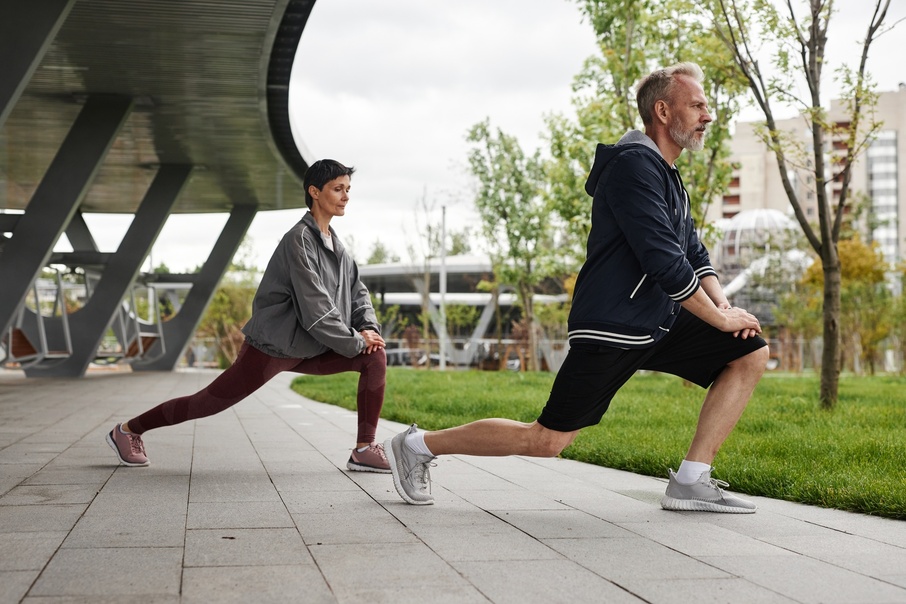
If your body feels stiff, your best first step may be mobility.
If you feel strong and prepared, strength training may be appropriate.
If your energy is low but your body needs activity, walking or Zone 2 metabolic work may be the right choice.
If you are sore, fatigued, or recovering from a demanding day, your movement may need to be restorative.
If you are moving well, recovering well, and feeling ready, that may be the right time for higher-output strength, metabolic, or power work.
The decision should not be random. It should be based on your readiness, your screening results, your goals, and the movement qualities your body needs most.
Before you choose today’s movement, use the short coaching pause below.
Listen Before You Build Your Movement Plan
This short coaching pause is designed to help you begin the Move More. Move Well. habit without overdoing it.
Use it before choosing your movement for the day, reviewing your Weekly Training Plan, or checking your Movement Meter inside the Vitality system.
Start With One Movement Action
After listening, choose one movement action that fits your current state.
You do not need to complete the perfect workout. You do not need to check every box. You do not need to fix mobility, strength, conditioning, and power all in the same day.
You need to build momentum with movement that matches your body and your current phase.
That may mean a 10-minute mobility session. It may mean a walk. It may mean a strength session. It may mean Zone 2 conditioning. It may mean loaded carries. It may mean recovery work. It may mean opening the Vitality App and completing the movement session your coach assigned.
The win is not doing everything.
The win is creating a repeatable rhythm.
Common Mistakes
One common mistake is thinking movement only counts when it is intense. Hard training has a place, but it is not the only form of valuable movement. Walking, mobility, balance work, breath-led recovery, and low-intensity aerobic work can all build capacity when repeated consistently.
Another mistake is skipping mobility because it does not feel like a workout. Mobility is not filler. It is how many clients begin restoring access to better movement. If you cannot rotate, reach, hinge, squat, lunge, or balance well, adding more intensity may not be the best first step.
A third mistake is doing too much too soon. Motivation can create a fast start, but capacity is built progressively. A plan that feels exciting for one week but leaves you sore, frustrated, or inconsistent is not the goal.
Many people also confuse soreness with progress. Soreness can happen when you introduce a new movement or training stimulus, but soreness is not the target. Adaptation is the target. The best plan is one that builds you up over time.
Finally, many people only train what they already like. Some love strength but avoid mobility. Some love cardio but avoid strength. Some love sport but avoid recovery. Some stretch constantly but never build force. The body needs a blend, and your screening helps clarify where your blend should begin.
How This Connects to Vitality Screenings
Vitality Screenings help identify which movement priorities deserve the most attention.
A movement screen may show that mobility is the best starting point. Strength testing may show that force production, grip, carries, or ground-to-stand capacity need work. Metabolic testing or conditioning assessments may show that aerobic capacity needs support. Power or balance testing may show that speed, coordination, or reactivity should be developed carefully.
Your Daily Readiness Observation tells us how you are doing today. Your Vitality Screening helps show the larger pattern. Your Weekly Training Plan organizes the prescription. Your Vitality App helps you execute.
Together, these tools help movement become more personalized.
Instead of asking, “What workout should I do?” the better question becomes:
What movement does my body need now, and how do I build it consistently over time?
Your Next Step
For the next seven days, use the Move More. Move Well. habit as your daily movement anchor.
Start by asking:
How much am I currently moving?
Then increase that amount by 20–30%.
Next, use the Movement Meter to see whether your week includes the right mix of mobility, strength, metabolic work, and power.
If you are rebuilding, begin with mobility. If you need more energy and endurance, add sustainable Zone 2 metabolic work. If you need more capacity, include strength patterns, carries, and whole-body movement. If you are ready for more challenge, your coach may progress you toward higher-level strength, power, or metabolic blocks.
You do not need the perfect program to start.
You need the right next step.
Move more often.
Move with purpose.
Move well.
Ready to Build Your Movement Foundation?
Use your Movement Meter, Vitality App, or Weekly Training Plan to choose your next movement action.
If you are unsure where to begin, a Vitality Screening can help identify whether your first priority should be mobility, strength, metabolic conditioning, power, or recovery-based movement.
Start where you are. Build gradually. Move More. Move Well.
References
Centers for Disease Control and Prevention. Adult Activity: An Overview. The CDC recommends adults accumulate at least 150 minutes of moderate-intensity physical activity weekly and include two days of muscle-strengthening activity.
https://www.cdc.gov/physical-activity-basics/guidelines/adults.html
Bull FC, Al-Ansari SS, Biddle S, et al. World Health Organization 2020 guidelines on physical activity and sedentary behaviour. The WHO recommends adults perform 150–300 minutes of moderate-intensity aerobic physical activity weekly, or an equivalent amount of vigorous activity, along with muscle-strengthening activities on two or more days weekly.
https://pmc.ncbi.nlm.nih.gov/articles/PMC7719906/
Liu CJ, Shiroy DM, Jones LY, Clark DO. Systematic review of functional training on muscle strength, physical functioning, and activities of daily living in older adults. European Review of Aging and Physical Activity. Functional training research supports the value of training movement patterns that carry over into daily life and physical function.
https://link.springer.com/article/10.1007/s11556-014-0144-1
ABOUT US
Founded in 2001, The team at Dynamic Health And Fitness believes that individuals must take a proactive, integrated approach on their personal vitality. Our mission is to provide the strategies and techniques necessary for individuals to enhance their lives and also impact those around them. We provide cutting edge programming that fuels our performance center and suite of mobile apps. Our goal is to become a leading resource for individuals, groups, and companies to create a needed shift in health.
The DHF Performance Center is located in the Syracuse, NY area and boasts world class training facilities with cutting edge technology to assist our clients in achieving their health, wellness, and performance goals.