




Active aging is not about avoiding decline, it is about preserving capacity. The ability to move confidently, generate strength, recover efficiently, regulate stress, and remain engaged with life is built through intentional action guided by meaningful information.
The Vitality Screening is designed to establish clear baselines across the systems that most strongly influence healthspan. Rather than guessing where to focus or reacting to symptoms alone, this process provides insight into how the body moves, adapts, recovers, and functions as an integrated whole. The goal is not to chase perfect numbers, but to understand your starting point and track how those capacities change over time.
Why We Screen
Health is multi-dimensional. Movement quality, strength, aerobic capacity, nervous system regulation, internal physiology, and social engagement all interact to determine how well we age. Screening allows us to see how these systems work together and where focus will have the greatest impact.
The Vitality Screening helps answer foundational questions:
-
How efficiently does the body move and stabilize under load?
-
How resilient are strength, power, and work-capacity systems?
-
How effectively does the body produce and recover energy?
-
How well does the nervous system regulate stress and sleep?
-
How do internal health markers support adaptation and recovery?
-
How does community and engagement influence overall vitality?
Rather than labeling problems, the screening establishes direction, allowing for focused and sustainable progress.
Movement & Performance Baselines
Movement is the foundation of independence and confidence as we age. These assessments evaluate how the body organizes motion, produces force, and maintains control across real-world demands.
3DMAPS® Mostability
The 3DMAPS® Mostability assessment evaluates how the body controls movement across multiple planes, revealing relationships between mobility and stability. Rather than isolating individual joints, it assesses how the body coordinates motion as an integrated system.
For active aging, movement quality is as important as movement quantity. Establishing a baseline here helps identify patterns that may limit efficiency, balance, or confidence, while providing a reference point for tracking improvements that support long-term mobility and fall prevention.
Half-Kneel to Balance
This transition-based assessment examines core control, hip stability, and balance during changes in position. These qualities are essential for everyday activities such as standing up, navigating stairs, and recovering from unexpected shifts in balance.
As we age, the ability to transition smoothly between positions becomes a key marker of independence. Baselines here help guide strategies that support confidence and reduce fall risk.
Grip Strength
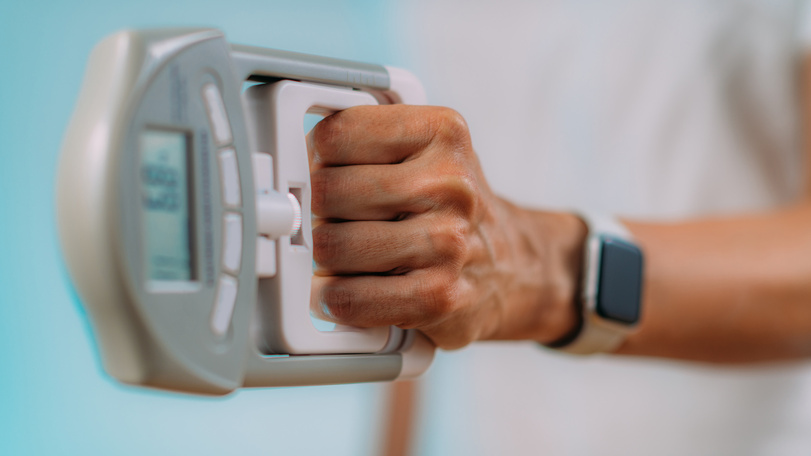
Grip strength reflects more than hand strength, it is a widely studied indicator of overall strength, nervous system efficiency, and long-term health outcomes. It represents the body’s ability to generate and transmit force.
In the context of healthspan, maintaining grip strength is strongly associated with better mobility, resilience, and functional capacity. Tracking grip strength over time helps guide strength priorities that support aging with confidence rather than fragility.
Dead Hang Test
The dead hang assesses upper-body strength, shoulder integrity, and grip endurance. These qualities contribute to joint health, posture, and the ability to manage body weight through the upper extremities.
Establishing a baseline provides insight into shoulder resilience and upper-body capacity, important components of maintaining movement options as we age.
Sprint-Drag-Carry (SDC) Test
The Sprint-Drag-Carry test evaluates work capacity, power, and movement efficiency under fatigue. It reflects how well the body handles repeated efforts that resemble real-world physical demands.
For active aging, this assessment provides insight into how the body tolerates stress and recovers between efforts, key factors for sustaining independence and physical confidence.
Davies Test
The Davies Test measures upper-body speed, coordination, and control, helping identify asymmetries and efficiency of force transfer.
Speed and coordination often decline earlier than strength alone. Tracking these qualities supports strategies that preserve reaction time and functional responsiveness.
Metabolic & Energy System Capacity
VO₂ Max Bike Test
VO₂ max represents how effectively the body delivers and utilizes oxygen during sustained effort. It reflects the combined efficiency of the heart, lungs, blood vessels, and muscles.
Aerobic capacity is one of the strongest predictors of long-term healthspan. Higher capacity is associated with improved metabolic health, cardiovascular resilience, and the ability to sustain daily activities with less fatigue. VO₂ max serves as a foundational baseline for endurance and energy system health over time.
Resting Metabolic Rate (RMR)
Resting Metabolic Rate measures how many calories the body requires at rest to support essential physiological functions such as breathing, circulation, cellular repair, and nervous system activity. It represents the energetic “cost of living” for the body before any movement or exercise is added.
From an active aging perspective, RMR provides critical insight into metabolic efficiency and adaptability. A suppressed or declining metabolic rate can influence energy levels, body composition, recovery capacity, and the ability to maintain lean tissue over time. Establishing an RMR baseline helps guide fueling strategies that support muscle preservation, metabolic health, and sustainable energy rather than chronic restriction or guesswork.
When combined with body composition, movement demands, and aerobic capacity, RMR helps create a clearer picture of how the body uses energy, and how nutrition strategies can better support long-term vitality rather than undermine it.
Body Composition & Cardiovascular Health
InBody Body Composition Analysis
Body composition provides insight into lean mass, fat mass, and distribution, factors that influence strength potential, metabolic health, and long-term disease risk.
Rather than focusing on appearance, body composition baselines help guide decisions that support muscle preservation, metabolic efficiency, and functional longevity.
Blood Pressure Screening
Blood pressure reflects cardiovascular health, stress response, and recovery capacity. Establishing a baseline provides important context for understanding how the body responds to daily demands and physical stress.
Sleep & Resilience
B.O.L.T. Screening
The B.O.L.T. score assesses breathing efficiency and tolerance to carbon dioxide, offering insight into respiratory control and nervous system balance. Breathing efficiency plays a central role in stress regulation and recovery.
Tracking this baseline helps guide strategies that support calmer breathing patterns and improved resilience.
Heart Rate Variability (HRV)
HRV reflects how effectively the nervous system adapts to stress and recovers between demands. It provides valuable insight into readiness, resilience, and recovery capacity.
Rather than chasing specific values, trends over time help determine whether stress and recovery strategies are supporting adaptation.
Pittsburgh Sleep Quality Index (PSQI)
The PSQI is a validated questionnaire that evaluates sleep quality and patterns. Sleep is foundational to recovery, cognition, metabolic health, and emotional regulation.
Establishing a baseline helps identify habits and patterns that may be limiting recovery and long-term vitality.
Blood Markers & Internal Health
CBP & CMP Panels
Foundational blood panels provide insight into internal physiology that movement and performance tests alone cannot reveal. These markers help assess metabolic health, organ function, electrolyte balance, hydration status, and key functional relationships.
Blood markers serve as an internal context layer, helping guide decisions related to recovery, fueling, and overall health support.
Community & Social Engagement
Social Wellness & Engagement Index
Healthspan is not built in isolation. Social connection, engagement, and purpose are strongly linked to long-term health and resilience.
This assessment evaluates how community and engagement support, or limit, overall vitality, reinforcing connection as a critical pillar of active aging.
How the Data Is Used
No single test defines vitality. The power of the Vitality Screening lies in integration, understanding how movement, performance, metabolism, recovery, internal health, and lifestyle factors interact.
Rather than changing everything at once, the data helps prioritize what matters most right now and provides a reference point for tracking progress over time. Trends, not perfection, guide the process.
Research & Expert Perspectives Supporting the Vitality Screening
The Vitality Screening framework aligns with contemporary research and expert perspectives that prioritize healthspan, functional capacity, and longitudinal tracking over isolated metrics.
Key areas of alignment include:
-
Cardiorespiratory fitness (VO₂ max) as a powerful predictor of longevity and overall healthspan, frequently emphasized by Peter Attia.
-
Grip strength and functional movement capacity as indicators of resilience, independence, and long-term outcomes in aging populations.
-
Movement quality, balance, and stability as foundational components of injury prevention and fall-risk reduction.
-
Nervous system regulation, breathing efficiency, sleep quality, and recovery capacity as central drivers of adaptation and metabolic health, highlighted in neuroscience and physiology research discussed by Andrew Huberman.
-
Longitudinal assessment and trend tracking as more meaningful than one-time measurements.
-
Social connection and engagement as contributors to longevity, cognitive health, and overall well-being.
These perspectives reinforce the philosophy behind the Vitality Screening: establish meaningful baselines, identify priorities, and guide intentional action over time.
ABOUT US
Founded in 2001, The team at Dynamic Health And Fitness believes that individuals must take a proactive, integrated approach on their personal vitality. Our mission is to provide the strategies and techniques necessary for individuals to enhance their lives and also impact those around them. We provide cutting edge programming that fuels our performance center and suite of mobile apps. Our goal is to become a leading resource for individuals, groups, and companies to create a needed shift in health.
The DHF Performance Center is located in the Syracuse, NY area and boasts world class training facilities with cutting edge technology to assist our clients in achieving their health, wellness, and performance goals.