I started strength training in the mid-1980s.
Like many people who began training during that era, my earliest exposure to resistance training came largely through bodybuilding. Programs were organized around body parts: chest, back, shoulders, arms and legs. You trained a muscle, recovered it and came back several days later to train it again.
And for the goal we were pursuing, it made sense.
We wanted to build muscle.
Over the years, I experimented with just about every version of that philosophy I could find. There were periods when I trained six days per week. At one point, influenced by extremely high-frequency Bulgarian-style training concepts, I experimented with training multiple times within the same day.
At other points, I moved in the opposite direction and stripped training back to basic compound movements performed three days per week.
The programs looked dramatically different on paper. The frequency changed. The exercises changed. The number of sets and repetitions changed.
But looking back, most of them were attempting to accomplish essentially the same thing:
muscular development.
Today, I don’t think there was anything inherently wrong with that.
In fact, developing and preserving skeletal muscle remains an important part of the DPR Method. The mistake would be believing that muscular development represents the entirety of physical development. It doesn’t. And it took years of training, coaching and aging for my thinking to fully evolve.
From bodybuilding to “functional training”
As my personal exploration of exercise became a career in coaching, the fitness industry was changing as well.
The conversation gradually expanded beyond muscles and exercises.
We started talking more about movement. Instead of simply asking which exercise trained the quadriceps, chest or latissimus, we began thinking about how the human body actually moves: pushing and pulling, squatting and hinging, rotating, stabilizing, accelerating and decelerating, moving through different planes and interacting with different environments. “Functional training” became the popular term.
Some of what eventually fell under that label was useful. Some of it became unnecessarily complicated. But the evolution forced an important change in my thinking:
Training a muscle and training a human being aren’t necessarily the same thing.
Traditional resistance exercises still had tremendous value. Squats didn’t suddenly become bad. Neither did presses, rows, deadlifts or loaded carries simply because the industry discovered movement.
The question became how to combine the best elements of traditional strength training with a broader understanding of human movement.
As my coaching experience accumulated, another variable entered the equation that ultimately became even more important.
I was aging alongside the people I coached.
The question changed
When you’re young and love training, it is easy to ask:
How much can I do?
As I moved through my career, I became increasingly interested in a different question:
How much do we actually need?
More specifically: What is the minimum amount of resistance training necessary to meaningfully improve or preserve strength, muscle and physical function? What amount might be optimal when someone has more time available?
And once we’ve earned someone’s two, three or four hours per week, what physical qualities deserve space within those hours?
Those questions became increasingly important because the people I was coaching weren’t professional athletes whose lives revolved around training. They had careers. Families. Vacations. Injuries. Stress. Poor nights of sleep. Aging joints. Changing goals.
They weren’t looking for exercise to become their life.
They wanted exercise to improve their life. And that’s an important distinction.
What does the science say about the minimum?
This is where my experience began intersecting with a growing body of research.
Public-health guidelines give us a useful starting point. The World Health Organization recommends that adults perform muscle-strengthening activity involving all major muscle groups on at least two days per week.
But public-health recommendations aren’t the same thing as an individualized training prescription, and the research becomes more interesting when we ask how little resistance training can still produce meaningful adaptation.
A review specifically examining minimal-dose resistance training concluded that relatively small amounts of resistance exercise can improve strength and physical function and may provide a practical strategy for reducing one of the largest barriers to exercise participation: time. The same review emphasizes something particularly important as we age: losses in strength and power can occur substantially faster than losses in muscle mass, and those qualities are strongly related to physical function.
Even among people who already resistance train, surprisingly low volumes can produce strength gains. A systematic review and meta-analysis found evidence that a single working set performed between one and three times per week could still produce measurable improvements in one-repetition-maximum strength in trained men. That doesn’t establish one set as optimal, it demonstrates that the threshold required to create some adaptation can be considerably lower than many people assume.
Maintenance may require even less than improvement. A review examining the minimum exercise dose needed to preserve performance found that, in younger populations, strength and muscle size could sometimes be maintained for extended periods with as little as one strength session per week and one set per exercise, provided training intensity was maintained. The authors noted that older adults may require closer to two sessions per week and two to three sets per exercise to preserve muscle size.
And the newest ACSM position stand reinforces the broader message. Its 2026 evidence review synthesized 137 systematic reviews involving more than 30,000 participants. One of its central conclusions is remarkably practical: for the average healthy adult, consistency matters more than unnecessarily complicated programming. Many techniques commonly treated as essential, including always training to failure, choosing one particular equipment type, or employing complex periodization, did not consistently determine outcomes.
That doesn’t mean programming doesn’t matter.
It means we need to be very clear about what we’re programming for.
Minimum Isn’t the Same as Optimal
Understanding the minimum effective dose of resistance training was useful, but it also raised a larger question for me. If meaningful improvements in strength and physical function can occur with relatively small amounts of training, the takeaway shouldn’t be that everyone should simply do as little as possible. Instead, the research helps us establish a floor, a level of training at which meaningful adaptation can begin. From there, programming becomes a question of determining what additional training is worthwhile based on the individual’s goals, available time, training history, recovery capacity and the physical qualities we are trying to develop.
That distinction between minimum and optimal became increasingly important as I worked with more people who weren’t athletes and didn’t organize their lives around training. For someone with a career, a family and a limited amount of time, adding more training simply because more is possible isn’t necessarily better programming. At the same time, meeting the minimum recommendation for resistance exercise doesn’t mean we’ve developed everything we would like that person to possess. The challenge is finding the appropriate dose while making intelligent use of the time we have.
This also forced me to reconsider what I meant by being “strong” or “fit.” Strength is important, but it represents only part of the picture. A person can increase muscle mass without maximizing strength, become substantially stronger without developing the ability to express that strength quickly, or demonstrate impressive strength in traditional gym exercises while still having limitations in balance, coordination, movement variability or the ability to repeatedly produce force. Conversely, someone can move extremely well but lack the strength and muscular capacity necessary to remain physically resilient as the demands of life increase and the aging process progresses.
Looking back at my own training made this particularly clear. For years I had experimented with very different programs, different exercises, splits, training frequencies, set-and-repetition schemes and methods, but many of them were still aimed primarily at the same adaptation: muscular development. I was changing the workout without necessarily changing the physiological objective of the workout. That realization eventually changed the way I thought about program design.
Training Should Have a Purpose, and That Purpose Should Change
Rather than asking one style of training to accomplish everything, I became increasingly interested in organizing training around distinct physiological objectives. If the body adapts specifically to the demands placed upon it, then a long-term program should deliberately manipulate those demands. There should be periods when we emphasize control and endurance, periods when we develop muscle, periods when we pursue higher levels of strength, and periods when we ask the body to express that strength more rapidly.
That thinking eventually developed into the five phases we use within the DPR Method: Stabilization Endurance, Strength Endurance, Muscular Development, Max Strength and Power. Each phase has a different primary objective, and therefore variables such as exercise selection, volume, intensity, repetitions, tempo, rest and movement complexity can change to support that objective.
The phases aren’t intended to suggest that one physical quality disappears when another becomes the emphasis. Moving into a Max Strength phase doesn’t mean endurance suddenly becomes irrelevant, just as entering a Power phase doesn’t mean we stop valuing strength. The distinction is one of priority. Certain qualities receive greater emphasis for a period of time while others are retained, allowing the training stimulus to change sufficiently to create continued adaptation.
That was a significant departure from how I had approached much of my own early training. Muscular development was no longer the program. It became one valuable adaptation within a much broader continuum. Hypertrophy matters, particularly as we age and preserving lean tissue becomes increasingly important, but so does the ability to produce force, sustain force, control force and eventually produce force quickly. A well-rounded resistance-training system needed a way to address all of those qualities over time rather than asking one training style to do everything indefinitely.
But What Movements Should We Train?
Periodization helped answer the question of what adaptation we are pursuing, but it didn’t completely answer the question of what we should actually do during the workout. This is where my evolution from traditional bodybuilding into functional training became important.
Bodybuilding had taught me a great deal about progressive resistance, overload, muscular development and the value of consistent training. I didn’t want to discard those lessons. At the same time, years of studying and coaching movement made it increasingly difficult for me to view the body simply as a collection of individual muscles. Human beings squat, hinge, push, pull, rotate, reach, get down to the ground and get back up. We interact with gravity and external loads from different positions and in multiple directions. We need to produce movement, but we also need the ability to resist movement and stabilize when the situation demands it.
For a period within the fitness industry, traditional strength training and “functional training” were often presented almost as opposing philosophies. I eventually came to believe that was a false choice. There was tremendous value in traditional strength training, and there was tremendous value in understanding integrated human movement. The better question wasn’t which philosophy should win; it was how do we intelligently combine them?
That question ultimately influenced the movement categories that now help organize DPR programming. Across the training model, we consider knee-dominant and hip-dominant movements, horizontal and vertical pushing and pulling, rotation and anti-rotation, ground-to-stand and on-ground movement, along with other movement demands appropriate to the individual and the phase. These categories aren’t specific exercises. They are programming responsibilities. A knee-dominant pattern doesn’t require every person to perform the same squat, just as horizontal pushing doesn’t require everyone to bench press. The category defines what we’re trying to accomplish; the exercise is the tool we select to accomplish it.
That distinction became increasingly important as my coaching shifted toward longevity and active aging. If someone is going to give us only two, three or four hours each week, I don’t want to fill that time with exercises simply because they’re familiar or because they happen to be exercises I personally enjoy. I want to know why each component is there, what physical quality it is intended to develop and how it contributes to the larger training objective.
At that point, the programming challenge became clearer. We had five different phases of training, each designed around a specific adaptation. We had a broad spectrum of movement categories that we wanted represented over time. We wanted enough variation to develop a more complete individual without creating random workouts. And we needed to accomplish all of this within a realistic amount of training time for people who have lives outside the gym.
Trying to put everything into every workout wasn’t the answer. Neither was eliminating important elements simply because someone could only train two or three times in a particular week. We needed a structure large enough to organize the complete program, but flexible enough to work within the realities of people’s schedules.
That problem is what eventually led to the DPR Four-Day Source Model.
Why Four Workouts Became the Source
The solution was not to put every movement category into every workout. It was to create enough programming space to distribute those demands intelligently. For DPR, that became a four-workout source model. Across those four workouts, we can balance hip- and knee-dominant movements, horizontal and vertical pushing and pulling, rotation and anti-rotation, ground-to-stand and on-ground movement, while adjusting the volume, intensity and exercise selection to match the goal of the current training phase.
Four workouts give us enough room to create a comprehensive program without turning every session into an exhaustive checklist. Just as importantly, the model gives us a consistent structure from which we can accommodate people who train two, three or four times per week.
What It Looks Like in Practice
Below are the four source workouts from our Stabilization Endurance phase.
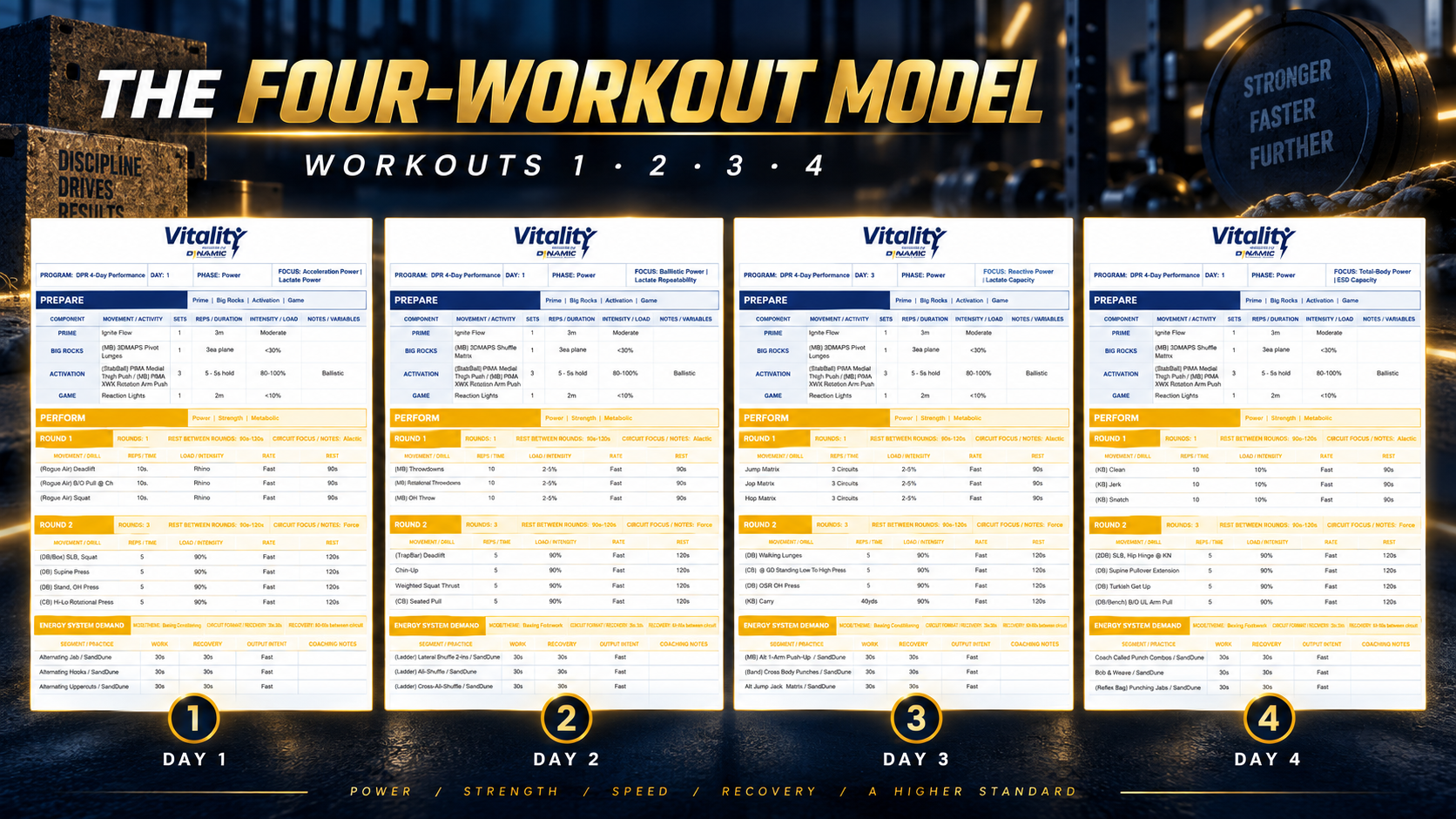
Each workout follows the DPR structure of Prepare → Perform → Recover, but the exercises and movement demands change across the four-workout sequence. The objective isn’t to make every day identical or to include every possible movement in every session. The objective is for the complete sequence to provide the appropriate exposure while remaining aligned with the physiological goal of the phase.
This same architecture carries into Strength Endurance, Muscular Development and Max Strength, with programming variables changing to produce the desired adaptation. Our Power phase becomes more specialized because speed, reaction, acceleration, deceleration and other power qualities require a somewhat different programming structure.
What If You Train Three—or Only Two—Days?
This is where the word source matters.
We don’t create a completely different program because someone trains three days instead of four. And we don’t compress four workouts into two oversized sessions. The four-workout sequence remains the source; training frequency determines how quickly you move through it.
|
Frequency |
Rotation |
|---|---|
|
4 days/week |
Week 1: 1–2–3–4 → Week 2: 1–2–3–4 |
|
3 days/week |
Week 1: 1–2–3 → Week 2: 4–1–2 → Week 3: 3–4–1 |
|
2 days/week |
Week 1: 1–2 → Week 2: 3–4 → Week 3: 1–2 |
The sequence doesn’t reset simply because a new week begins.
Someone training twice per week will obviously accumulate training exposure differently from someone training four times per week. We aren’t suggesting otherwise. What the DPR model prevents is someone’s schedule arbitrarily determining which parts of a well-rounded program they never receive.
A Framework, Not a Cookie-Cutter Program
The four workouts provide the framework, but they aren’t meant to make every person train identically. This is where another principle of the DPR Method becomes important: 90/10.
Approximately 90% of the program provides the structure appropriate to the phase and its intended adaptation. The remaining 10% allows us to individualize based on the person’s assessment, goals, training history and response to movement. When an exercise doesn’t fit, we can tweak the movement, changing variables such as position, range, load, direction or complexity, without unnecessarily abandoning the purpose of the program.
Those concepts deserve their own discussion. For now, the important point is that structure and individualization don’t have to compete with each other.
Where This Evolution Has Led Me
Nearly four decades after I began training, I still believe resistance training is one of the most valuable things we can do for our physical capacity and longevity. What has changed considerably is how I believe it should be organized.
The DPR Method is the result of that evolution: assess the individual, define the goal, train through purposeful phases, organize movement across a complete programming framework, and individualize where necessary.
There isn’t one perfect workout.
There should be a purposeful system that can evolve with the person using it.
References
- Currier BS, D’Souza AC, Fiatarone Singh MA, et al. Resistance Training Prescription for Muscle Function, Hypertrophy, and Physical Performance in Healthy Adults: An Overview of Reviews. Medicine & Science in Sports & Exercise. 2026;58(4):851–872. doi:10.1249/MSS.0000000000003897.
- Fyfe JJ, Hamilton DL, Daly RM. Minimal-Dose Resistance Training for Improving Muscle Mass, Strength, and Function: A Narrative Review of Current Evidence and Practical Considerations. Sports Medicine. 2022;52:463–479. doi:10.1007/s40279-021-01605-8.
- Androulakis-Korakakis P, Fisher JP, Steele J. The Minimum Effective Training Dose Required to Increase 1RM Strength in Resistance-Trained Men: A Systematic Review and Meta-Analysis. Sports Medicine. 2020;50(4):751–765. doi:10.1007/s40279-019-01236-0.
- Spiering BA, Mujika I, Sharp MA, Foulis SA. Maintaining Physical Performance: The Minimal Dose of Exercise Needed to Preserve Endurance and Strength Over Time. Journal of Strength and Conditioning Research.2021;35(5):1449–1458. doi:10.1519/JSC.0000000000003964.
- World Health Organization. WHO Guidelines on Physical Activity and Sedentary Behaviour. Geneva: World Health Organization; 2020.
ABOUT US
Founded in 2001, The team at Dynamic Health And Fitness believes that individuals must take a proactive, integrated approach on their personal vitality. Our mission is to provide the strategies and techniques necessary for individuals to enhance their lives and also impact those around them. We provide cutting edge programming that fuels our performance center and suite of mobile apps. Our goal is to become a leading resource for individuals, groups, and companies to create a needed shift in health.
The DHF Performance Center is located in the Syracuse, NY area and boasts world class training facilities with cutting edge technology to assist our clients in achieving their health, wellness, and performance goals.