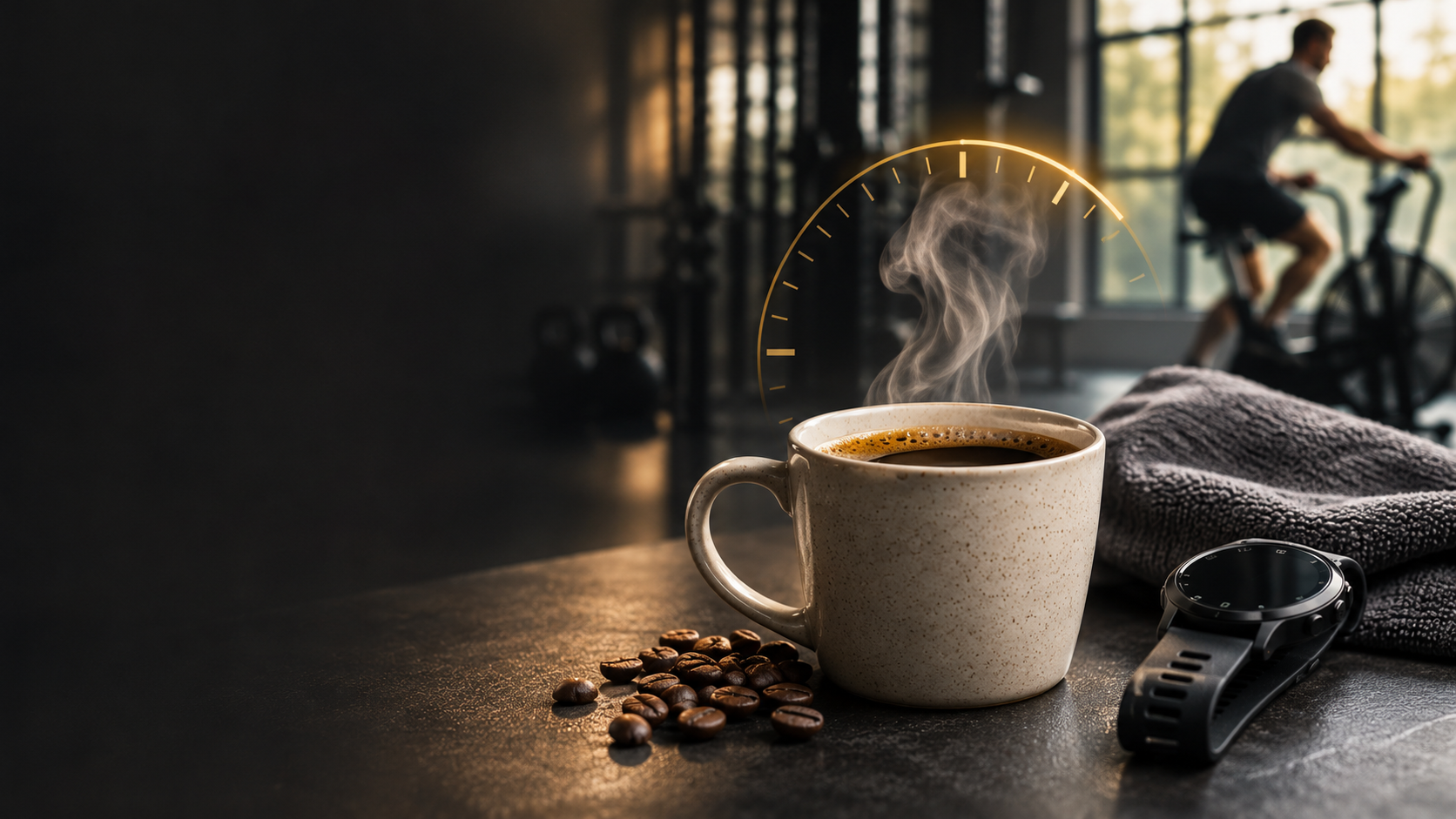
One of the most researched performance-enhancing substances can improve energy, focus and physical performance. But the amount you consume, and when you consume it, can make a significant difference.
Caffeine is one of the most widely consumed stimulants in the world and one of the most extensively studied ergogenic aids, meaning a substance capable of improving physical performance.
Research supports its effectiveness for aerobic endurance, muscular endurance, alertness and certain strength and power activities.
However, caffeine also presents an interesting trade-off: the same substance that enhances performance during the day can interfere with sleep and recovery later.
Understanding its benefits, limitations and appropriate use is essential.
1. How Does Caffeine Work?
Caffeine primarily works by blocking adenosine receptors in the central nervous system.
Adenosine is a chemical messenger involved in the development of sleep pressure. As we remain awake, adenosine signaling contributes to increasing feelings of tiredness.
By blocking those receptors, caffeine can temporarily reduce perceived fatigue and increase alertness.
During exercise, caffeine may also help:
-
Reduce perceived exertion, making a demanding activity feel more manageable.
-
Increase vigilance, concentration and reaction-related performance.
-
Improve endurance capacity and muscular endurance.
-
Enhance selected measures of strength, power and movement velocity.
These effects are not universal. Genetics, habitual caffeine consumption, individual sensitivity and exercise type can influence the response.
2. What Does Scientific Research Say About Performance?
The International Society of Sports Nutrition (ISSN) published a comprehensive position stand evaluating caffeine’s effects on exercise performance.
Its conclusions support benefits across several performance domains.
Aerobic endurance — Strong evidence
Endurance exercise has some of the most consistent research support. A review of 46 studies cited in the ISSN position stand found modest but meaningful average improvements in endurance time-trial performance.
For recreational exercisers and competitive athletes alike, improvements in exercise capacity may help support training quality.
Muscular endurance — Moderate to strong evidence
Caffeine can improve the ability to perform repeated muscular contractions, although responses depend on the exercise, dose and person.
Strength and power — Moderate evidence
Studies report small improvements in certain strength, jumping, throwing and movement-velocity outcomes. Benefits are generally less consistent than those observed in endurance exercise.
Attention and vigilance — Supportive evidence
Caffeine can improve attention, vigilance and alertness, making it useful in situations requiring sustained concentration.
Importantly, caffeine does not improve every performance measure in every person. A well-rested individual may also respond differently from someone experiencing fatigue or sleep deprivation.
3. How Much Caffeine Is Needed?
The most consistently researched performance-enhancing range is 3–6 milligrams per kilogram of body weight (mg/kg).
However, emerging research suggests that lower doses may also improve performance, particularly in endurance activities.
| Body weight | 2 mg/kg | 3 mg/kg | 6 mg/kg |
|---|---|---|---|
| 120 lb | 109 mg | 163 mg | 327 mg |
| 150 lb | 136 mg | 204 mg | 408 mg |
| 180 lb | 163 mg | 245 mg | 490 mg |
| 200 lb | 181 mg | 272 mg | 544 mg |
These calculations illustrate research doses, not individualized recommendations.
The higher numbers are particularly important to understand. A dose shown to improve athletic performance in a study can exceed what is appropriate for someone’s daily caffeine intake.
The FDA cites 400 mg per day as an amount not generally associated with adverse effects for most healthy adults. This is not a recommended daily goal or a guarantee of safety.
A practical principle is to start with the lowest effective dose rather than automatically pursuing the highest dose studied.
Very high doses may increase adverse effects without delivering proportional performance benefits.
4. When Should Caffeine Be Consumed Before Exercise?
A common research protocol involves consuming caffeine approximately 60 minutes before exercise.
However, timing depends on the delivery method and individual response.
Coffee, capsules, energy drinks and caffeinated gum do not necessarily produce identical absorption patterns.
For many individuals, noticeable effects develop within approximately 15–45 minutes, although perceived effects and peak concentrations may occur at different times.
Someone exercising early in the morning may find a modest amount of caffeine helpful. Someone training in the evening may decide the potential performance benefit is not worth the effect on sleep.
Timing should support overall health and recovery, not simply the immediate workout.
5. How Long Does Caffeine Stay in the Body?
One of caffeine’s most important characteristics is its relatively long half-life.
The half-life is the time required for the body to eliminate approximately half of the caffeine present.
A typical caffeine half-life is approximately 5–6 hours, but metabolism varies substantially. In some adults, the half-life may be considerably shorter or longer.
Consider a person consuming 200 mg of caffeine at 2 PM, assuming a five-hour half-life:
| Time | Approximate caffeine remaining |
|---|---|
| 2 PM | 200 mg |
| 7 PM | 100 mg |
| Midnight | 50 mg |
| 5 AM | 25 mg |
This is a simplified illustration. It is not an exact measurement of caffeine concentrations or an individual’s metabolism.
The important distinction is that no longer feeling stimulated does not mean caffeine has left the body.
6. Can Afternoon Caffeine Interfere With Sleep?
Yes. And the dose matters.
A randomized crossover trial published in Sleep examined 100 mg and 400 mg caffeine doses consumed 4, 8 and 12 hours before bedtime.
The researchers found that:
-
A 400 mg dose disrupted several measures of sleep when consumed within 12 hours of bedtime.
-
Sleep fragmentation increased when 400 mg was consumed within eight hours of bedtime.
-
The 100 mg dose did not produce statistically significant sleep disruption under the conditions studied.
The study involved 23 young adult men, so its results should not be interpreted as a universal caffeine cutoff for every person.
Nevertheless, the findings highlight an important point: higher doses may have longer-lasting consequences for sleep than people realize.
What about caffeine after 3 or 4 PM?
For someone going to bed at 10 PM, a 4 PM coffee leaves only six hours before bedtime.
A substantial amount of caffeine may still remain in the body when that person is trying to sleep.
As a conservative starting point, individuals concerned about sleep quality may benefit from stopping caffeine approximately 8–10 hours before bedtime. Highly sensitive individuals or those consuming larger doses may need a longer interval.
There is no single cutoff appropriate for everyone.
7. Contraindications and Potential Side Effects
Although caffeine is generally well tolerated in moderate amounts by many healthy adults, it is not suitable for everyone.
Potential adverse effects include:
-
Anxiety, nervousness and jitteriness
-
Increased heart rate or palpitations
-
Temporary increases in blood pressure
-
Digestive discomfort or nausea
-
Difficulty falling asleep or maintaining sleep
-
Headaches and withdrawal symptoms when habitual intake is reduced abruptly
Individuals with certain heart rhythm disorders, uncontrolled blood pressure, significant anxiety, sleep disorders or other relevant medical conditions should seek individualized medical guidance.
Caffeine may also interact with medications or have prolonged effects when metabolism is altered.
During pregnancy, the American College of Obstetricians and Gynecologists advises limiting total caffeine intake to less than 200 mg per day. Individuals who are pregnant, breastfeeding or trying to become pregnant should consult their healthcare professional.
Children and adolescents should not use adult performance-dosing protocols.
8. Coffee Versus Caffeine Supplements
Coffee is a convenient source of caffeine, but its caffeine content is not standardized.
Bean variety, roasting, brewing method, serving size and concentration all influence caffeine delivery.
Cold brew is not automatically higher in caffeine than hot coffee. The amount depends on how it is prepared and diluted.
Caffeine tablets and some supplements may provide more precisely measured doses, but that does not automatically make them a better or safer choice.
High-dose pre-workout products may also contain other stimulants.
The key is to evaluate total caffeine intake from all sources, including coffee, tea, energy drinks, supplements and certain medications.
9. Best Practices for Using Caffeine
A practical, evidence-informed approach includes:
-
Define the purpose. Is caffeine being used for alertness, concentration, exercise performance or simply enjoyment?
-
Start conservatively. Lower doses may provide benefits without unnecessary side effects.
-
Know the amount. Check product labels and recognize the variability in coffee and cold-brew preparations.
-
Consider exercise timing. Approximately 60 minutes before exercise is a common research approach, but is not mandatory.
-
Protect sleep. Adjust the last caffeine serving according to bedtime, dose and sensitivity.
-
Monitor individual response. Pay attention to perceived performance, anxiety, heart rate and sleep quality.
-
Avoid using caffeine to compensate routinely for inadequate sleep. Stimulation cannot replace the physiological benefits of sufficient rest.
10. The Bottom Line
Caffeine has substantial scientific support as a performance-enhancing substance, especially for endurance activities, with additional evidence for muscular endurance, strength, power and cognitive vigilance.
But effective use requires more than knowing that caffeine works.
Dose, timing, tolerance, health status and sleep quality all influence whether caffeine provides a net benefit.
The objective should not be maximizing caffeine consumption. It should be understanding when modest, intentional use offers a meaningful benefit—and when avoiding it is the better decision.
Performance enhancement should never come at the expense of long-term recovery and health.
Scientific References
-
Guest NS, et al. (2021). International Society of Sports Nutrition Position Stand: Caffeine and Exercise Performance. Journal of the International Society of Sports Nutrition. https://doi.org/10.1186/s12970-020-00383-4
-
ISSN (2023). International Society of Sports Nutrition Position Stand: Coffee and Sports Performance.https://pubmed.ncbi.nlm.nih.gov/37498180/
-
Dose and Timing Effects of Caffeine on Subsequent Sleep: A Randomized Clinical Crossover Trial. Sleep, 2025. https://pubmed.ncbi.nlm.nih.gov/39377163/
-
U.S. Food and Drug Administration. Spilling the Beans: How Much Caffeine Is Too Much?https://www.fda.gov/consumers/consumer-updates/spilling-beans-how-much-caffeine-too-much
-
CDC/NIOSH. Caffeine: Improving Sleep and Alertness. https://www.cdc.gov/niosh/work-hour-training-for-nurses/longhours/mod6/11.html
-
American College of Obstetricians and Gynecologists. How Much Coffee Can I Drink While I’m Pregnant?https://www.acog.org/womens-health/experts-and-stories/ask-acog/how-much-coffee-can-i-drink-while-pregnant
This article is intended for general education and does not replace individualized medical.
ABOUT US
Founded in 2001, The team at Dynamic Health And Fitness believes that individuals must take a proactive, integrated approach on their personal vitality. Our mission is to provide the strategies and techniques necessary for individuals to enhance their lives and also impact those around them. We provide cutting edge programming that fuels our performance center and suite of mobile apps. Our goal is to become a leading resource for individuals, groups, and companies to create a needed shift in health.
The DHF Performance Center is located in the Syracuse, NY area and boasts world class training facilities with cutting edge technology to assist our clients in achieving their health, wellness, and performance goals.