

How Your Body Creates Energy—and How to Train It
Walking up a flight of stairs, carrying groceries, hiking, riding a bike, playing pickleball and completing a hard interval all require the same immediate energy currency: adenosine triphosphate, or ATP.
Your muscles store only a small amount of ATP, so your body must continuously rebuild it. How quickly ATP must be regenerated, and which fuel contributes most, changes with the intensity and duration of the task.
That is the purpose of Energy System Demand training. It is not simply “cardio,” burning calories or getting your heart rate as high as possible. It is the deliberate development of your ability to create energy, sustain meaningful work and recover for what comes next.
At DPR, we organize that foundation around three complementary demands:
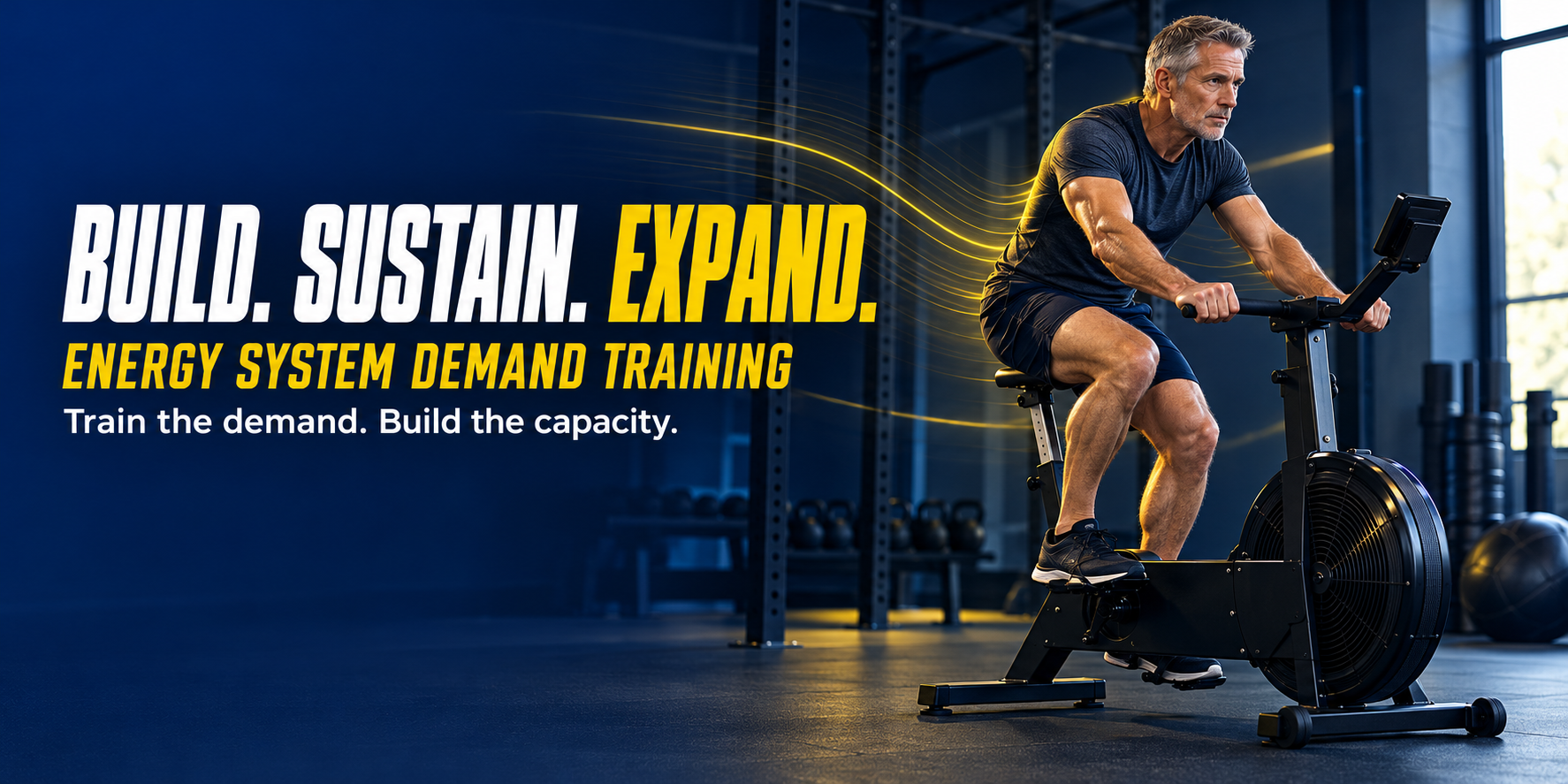
BUILD the base. SUSTAIN the work. EXPAND the ceiling.
One Energy Currency, Three Overlapping Pathways
The body is often described as having three energy systems, but it is important to understand that they do not switch on and off. All three contribute at the same time. The rate and duration of the activity change their relative contribution.[9]
The Phosphagen System: Immediate Energy
For a brief, powerful effort such as accelerating, jumping, lifting something heavy or producing a short sprint, the body needs ATP almost immediately.
The phosphagen system uses stored ATP and phosphocreatine to regenerate energy very quickly. It can produce a great deal of power, but its capacity is limited. As those immediate stores decline, the contribution from glycolytic and oxidative metabolism increases.[8,9]
This system matters beyond athletics. The ability to produce force quickly may determine whether you can catch your balance, climb a steep step or move an object safely.
The Glycolytic System: Faster Energy From Carbohydrate
As an effort continues or becomes harder, the body increasingly uses glucose circulating in the blood and glycogen stored in the muscles and liver.
Glycolysis can regenerate ATP relatively quickly and supports activities that are too demanding to be powered primarily by slower oxidative metabolism. It becomes increasingly important during sustained hard work, repeated intervals and efforts that create the familiar rise in breathing and muscular fatigue.
Carbohydrate is not a “bad” fuel. It is the body’s most accessible fuel when the required rate of energy production increases.
The Oxidative System: Mitochondrial Energy
During longer and more sustainable activity, the body relies more heavily on oxygen-dependent energy production within the mitochondria.
The mitochondria can use both carbohydrate-derived products and fatty acids to generate large amounts of ATP. Fat generally contributes more during lower-intensity, longer-duration work, while reliance on carbohydrate rises as intensity increases. The crossover is gradual, not an on-and-off switch, and it differs among individuals.[1]
The oxidative system also helps restore phosphocreatine and recover between harder efforts.[8] A stronger aerobic system does not only help you go longer. It helps you recover faster and repeat quality work.
Why the Mitochondria Matter
Mitochondria are sometimes described as the power plants of the cells. That description is useful, but incomplete.
Their number, function and ability to process available fuel influence how efficiently your muscles can meet an energy demand. Exercise training can increase skeletal-muscle mitochondrial content and improve the machinery used to oxidize carbohydrate and fat.[2,14]
This is one reason a trained person can perform the same walking pace, cycling workload or flight of stairs with less disruption. The task did not become easier. The person became better equipped to meet its energy cost.
Different training intensities provide different signals. Longer, controlled work develops the ability to produce energy efficiently over time. Sustained moderate-to-hard work challenges the ability to maintain a higher output. Carefully dosed high-intensity intervals expose the cardiovascular and muscular systems to demands near the upper end of aerobic capacity.
We need all three, but not in equal amounts and not at maximal intensity every day.
Energy-System Health Is Healthspan
Cardiorespiratory fitness is strongly associated with cardiovascular health and long-term health outcomes. Across large population studies, people with higher cardiorespiratory fitness generally demonstrate lower rates of cardiovascular events and premature mortality.[3]
Energy-system training is also relevant to metabolic syndrome, a cluster of risk factors that includes abdominal obesity, elevated blood pressure, elevated fasting glucose, elevated triglycerides and low HDL cholesterol.[13]
The muscles are a major destination for glucose and a major site of fuel use. When they repeatedly contract, take up fuel and generate ATP, the body receives a reason to improve oxygen delivery, mitochondrial capacity, insulin signaling and vascular function.
In a randomized pilot study of adults with metabolic syndrome, both continuous moderate exercise and aerobic interval training improved fitness. The interval group demonstrated larger improvements in VO₂ max and several cardiometabolic measures, including endothelial function and insulin signaling.[4] That does not mean every person should perform high-intensity intervals immediately. It means intensity can be a powerful tool when the individual has been properly screened and prepared.
Exercise is not a substitute for medical management. However, a well-designed energy-system program can directly train several of the physical capacities connected to metabolic and cardiovascular health.
Start by Identifying the Person’s Current Capacity
Two people of the same age can have very different cardiovascular capacities and very different responses to the same heart rate, speed or incline.
This is why generic formulas have limitations. Preparticipation screening should consider current activity, known cardiovascular, metabolic or renal disease, signs or symptoms, and the intended exercise intensity. People with symptoms or relevant medical conditions may require medical clearance or clinically supervised testing before vigorous exercise.[10]
What VO₂ Max Measures
VO₂ max is the highest rate at which the body can take in oxygen, transport it through the cardiovascular system and use it during demanding whole-body exercise. It reflects the integrated capacity of the lungs, heart, circulation, blood and working muscles, not the performance of one organ in isolation.[5]
VO₂ max is commonly expressed as milliliters of oxygen used per kilogram of body weight per minute. It gives us an important measurement of the person’s aerobic ceiling, but the test can reveal more than one final number.
VT1: The First Ventilatory Threshold
VT1 marks the point at which breathing begins to increase disproportionately relative to the workload. Below or near VT1, effort is generally sustainable and conversation remains possible.
This area helps guide the intensity used to build the aerobic foundation.
VT2: The Second Ventilatory Threshold
VT2 occurs at a higher intensity, when ventilation rises more sharply and maintaining the workload becomes increasingly difficult. Conversation is reduced to short phrases, and the effort cannot be sustained indefinitely.
This threshold helps identify the transition toward the upper aerobic and severe-intensity domain used during carefully prescribed interval training.
Direct threshold measurements are valuable because age-predicted percentages can place different people in very different physiological domains. Research comparing traditional percentage-based zones with measured VT1 and VT2 has demonstrated meaningful individual variation, particularly among people with cardiovascular conditions.[6]
A wearable estimate can provide a useful trend. A properly performed VO₂ assessment gives the coach a more individualized starting point.
How Do You Know How Hard You Are Working?
No single measurement tells the entire story. DPR combines several forms of feedback.
Heart-rate zones provide an objective estimate of internal cardiovascular demand. They are most useful when they are based on measured physiology rather than an age-only formula.
Rate of perceived exertion, or RPE, describes how difficult the work feels on a scale from very easy to maximal. RPE is a validated measure of internal training load and complements objective measures such as heart rate.[12] It can reflect information a heart-rate monitor cannot fully see, including heat, fatigue, stress, poor sleep, illness and accumulated workload.
The talk test provides immediate practical feedback. Research generally places comfortable speech below the ventilatory or lactate threshold and loss of comfortable speech above it.[11] Short phrases therefore suggest a higher demand, while an inability to speak more than a few words signals that the effort has moved substantially higher.
External rate describes what you are producing: walking or running speed, cycling wattage or cadence, rowing pace, swimming pace, grade, load or distance.
The best prescription connects the external task to the internal response.
The Environment Is a Tool
The heart and mitochondria do not care whether the energy demand came from a treadmill, bicycle, rower, swimming pool or trail. The training environment matters because it changes how precisely the demand can be controlled and how safely the person can produce it.
For foundational ESD training, DPR generally favors repeatable cyclical activities that predominantly move forward through the sagittal plane. Walking, running, cycling, rowing and swimming allow rate, intensity and duration to be observed and reproduced with fewer moving parts.
Hiking and rucking can also be effective, although terrain, elevation, weather and carried load make the dose less standardized. Sprinting can create a powerful demand, but it also requires greater tissue capacity, skill and preparation. It should not be treated as the default way to perform high-intensity conditioning.
Multi-directional circuits and sport-specific conditioning have value. They simply introduce more variables. When the objective is to target a specific energy-system response, simpler modes often make the prescription easier to control.
The DPR Foundational ESD Plan
Clients will see three foundational Energy System Demand workouts in the DPR Vitality Coach app. They are not three versions of the same workout. Each creates a different demand.
BUILD: Develop the Aerobic Foundation
BUILD is 40–60 minutes of steady Zone 2 activity at a conversational effort, generally below or near the individual’s first ventilatory threshold.
The purpose is to accumulate sustainable work, improve aerobic efficiency and develop the mitochondrial and cardiovascular foundation that supports both health and recovery.
BUILD should feel controlled. The client should finish knowing that additional work would have been possible. Walking, incline walking, cycling, rowing or swimming may all be appropriate depending on the individual.
This is not “doing nothing.” It is developing the system that allows everything else to recover and improve.
SUSTAIN: Maintain Meaningful Work
SUSTAIN introduces controlled periods of Zone 3 work separated by easier Zone 2 recovery.
The standard structure is a five-minute warm-up, followed by three rounds of six minutes in Zone 3 and two minutes in Zone 2, followed by a four-minute cooldown. Total time is approximately 33 minutes.
The purpose is to improve the ability to maintain a meaningful output above the comfortable aerobic base without turning the session into an all-out test.
The work intervals should feel purposeful and challenging but repeatable. The client should be able to complete the final interval with the same general quality and control as the first.
EXPAND: Raise the Aerobic Ceiling
EXPAND uses the Norwegian 4×4 interval structure to accumulate high-quality work near the upper end of aerobic capacity.
The session begins with a 10-minute progressive warm-up. The client then completes four four-minute work intervals, with three minutes of active Zone 2 recovery between intervals, followed by a five-minute cooldown. Total time is approximately 40 minutes.
During each work interval, intensity builds progressively toward approximately 90–95% of maximum heart rate, with an RPE generally between 7 and 9 out of 10. The effort should be strong and repeatable, not a maximal sprint.
The first interval may take time to reach the target range. That is expected. The goal is not to force the heart rate upward immediately; it is to accumulate controlled time at a sufficiently high oxygen demand.
In a randomized study of 40 healthy, moderately trained men, both short intervals and the Norwegian 4×4 improved VO₂ max more than moderate continuous or threshold training. The 4×4 group improved VO₂ max by approximately 7% across eight weeks.[7] That result supports the protocol; it does not guarantee the same response for every client. Other interval formats can also be effective, but the 4×4 provides a repeatable and well-studied structure.
Three Workouts—Not Three Hard Days
The foundational plan works because the demands are different.
BUILD develops the floor. SUSTAIN strengthens the middle. EXPAND raises the ceiling.
The workouts do not automatically become harder every week. Progress may appear as a faster pace at the same heart rate, greater output at the same RPE, improved recovery between intervals, a lower heart rate at a familiar workload or a higher measured VO₂ max.
The coach may adjust the modality, duration, interval dose or intensity based on the client’s screening results, movement capacity, health history, recovery and performance. The app provides structure, but the schedule is flexible. If life requires a workout to move to another day, the client continues the plan rather than starting over.
Specialty formats, including shorter intervals, sprint work, hill sessions, rucking, mixed-modal conditioning, the DPR Miler or Metabolic Cranks, may be useful when they match a specific goal. They do not replace the need for a well-rounded aerobic foundation.
Train the Demand You Want to Improve
Energy System Demand training is not about chasing exhaustion.
It is about teaching the body to create ATP at the rate the task requires, use available fuel more effectively, transport and use oxygen, recover between efforts and remain capable as the demand changes.
That is why the DPR plan contains three different workouts.
BUILD the system that supports the work.
SUSTAIN the output required by life and activity.
EXPAND the ceiling so greater demands become possible.
The goal is not to make every day hard.
The goal is to make your body more capable.
A Note About the Evidence
The physiology and health claims in this article are supported by peer-reviewed reviews, meta-analyses, practice guidance and controlled trials listed below. The precise BUILD, SUSTAIN and EXPAND organization is DPR’s coaching model: it is an applied framework informed by this evidence, not a branded protocol that has itself been tested as a single research intervention. Individual responses vary, and exercise testing or medical clearance may be appropriate before beginning vigorous training.
References
-
Romijn JA, Coyle EF, Sidossis LS, et al. Regulation of endogenous fat and carbohydrate metabolism in relation to exercise intensity and duration. American Journal of Physiology-Endocrinology and Metabolism. 1993;265(3 Pt 1)–E391. doi: 10.1152/ajpendo.1993.265.3.E380
-
Perry CGR, Heigenhauser GJF, Bonen A, Spriet LL. High-intensity aerobic interval training increases fat and carbohydrate metabolic capacities in human skeletal muscle. Applied Physiology, Nutrition, and Metabolism. 2008;33(6):1112–1123. doi: 10.1139/H08-097
-
Kodama S, Saito K, Tanaka S, et al. Cardiorespiratory fitness as a quantitative predictor of all-cause mortality and cardiovascular events in healthy men and women: A meta-analysis. JAMA. 2009;301(19):2024–2035. doi: 10.1001/jama.2009.681
-
Tjønna AE, Lee SJ, Rognmo Ø, et al. Aerobic interval training versus continuous moderate exercise as a treatment for the metabolic syndrome: A pilot study. Circulation. 2008;118(4):346–354. doi: 10.1161/CIRCULATIONAHA.108.772822
-
Hawkins MN, Raven PB, Snell PG, Stray-Gundersen J, Levine BD. Maximal oxygen uptake as a parametric measure of cardiorespiratory capacity. Medicine & Science in Sports & Exercise. 2007;39(1):103–107. doi: 10.1249/01.mss.0000241641.75101.64
-
Anselmi F, Cavigli L, Pagliaro A, et al. The importance of ventilatory thresholds to define aerobic exercise intensity in cardiac patients and healthy subjects. Scandinavian Journal of Medicine & Science in Sports. 2021;31(9):1796–1808. doi: 10.1111/sms.14007
-
Helgerud J, Høydal K, Wang E, et al. Aerobic high-intensity intervals improve VO₂ max more than moderate training. Medicine & Science in Sports & Exercise. 2007;39(4):665–671. doi: 10.1249/mss.0b013e3180304570
-
Bogdanis GC, Nevill ME, Boobis LH, Lakomy HKA. Contribution of phosphocreatine and aerobic metabolism to energy supply during repeated sprint exercise. Journal of Applied Physiology. 1996;80(3):876–884. doi: 10.1152/jappl.1996.80.3.876
-
Gastin PB. Energy system interaction and relative contribution during maximal exercise. Sports Medicine. 2001;31(10):725–741. doi: 10.2165/00007256-200131100-00003
-
Riebe D, Franklin BA, Thompson PD, et al. Updating ACSM’s recommendations for exercise preparticipation health screening. Medicine & Science in Sports & Exercise. 2015;47(11):2473–2479. doi: 10.1249/MSS.0000000000000664
-
Reed JL, Pipe AL. The talk test: A useful tool for prescribing and monitoring exercise intensity. Current Opinion in Cardiology. 2014;29(5):475–480. doi: 10.1097/HCO.0000000000000097
-
Foster C, Florhaug JA, Franklin J, et al. A new approach to monitoring exercise training. Journal of Strength and Conditioning Research. 2001;15(1):109–115. doi: 10.1519/00124278-200102000-00019
-
Grundy SM, Cleeman JI, Daniels SR, et al. Diagnosis and management of the metabolic syndrome: An American Heart Association/National Heart, Lung, and Blood Institute scientific statement. Circulation. 2005;112(17):2735–2752. doi: 10.1161/CIRCULATIONAHA.105.169404
-
Granata C, Jamnick NA, Bishop DJ. Training-induced changes in mitochondrial content and respiratory function in human skeletal muscle. Sports Medicine. 2018;48(8):1809–1828. doi: 10.1007/s40279-018-0936-y
ABOUT US
Founded in 2001, The team at Dynamic Health And Fitness believes that individuals must take a proactive, integrated approach on their personal vitality. Our mission is to provide the strategies and techniques necessary for individuals to enhance their lives and also impact those around them. We provide cutting edge programming that fuels our performance center and suite of mobile apps. Our goal is to become a leading resource for individuals, groups, and companies to create a needed shift in health.
The DHF Performance Center is located in the Syracuse, NY area and boasts world class training facilities with cutting edge technology to assist our clients in achieving their health, wellness, and performance goals.